EQT Q1 2026 Brief: Appalachian Gas, Curtailments, and PA/WV State-Source Signals
EQT Q1 2026 earnings showed higher Appalachian gas volumes, record free cash flow, Q2 curtailments, and PA/WV state-source signals.
By Johnathan · Reviewed by EnergyNetWatch Research · Last updated 2026-05-08
Key Takeaways
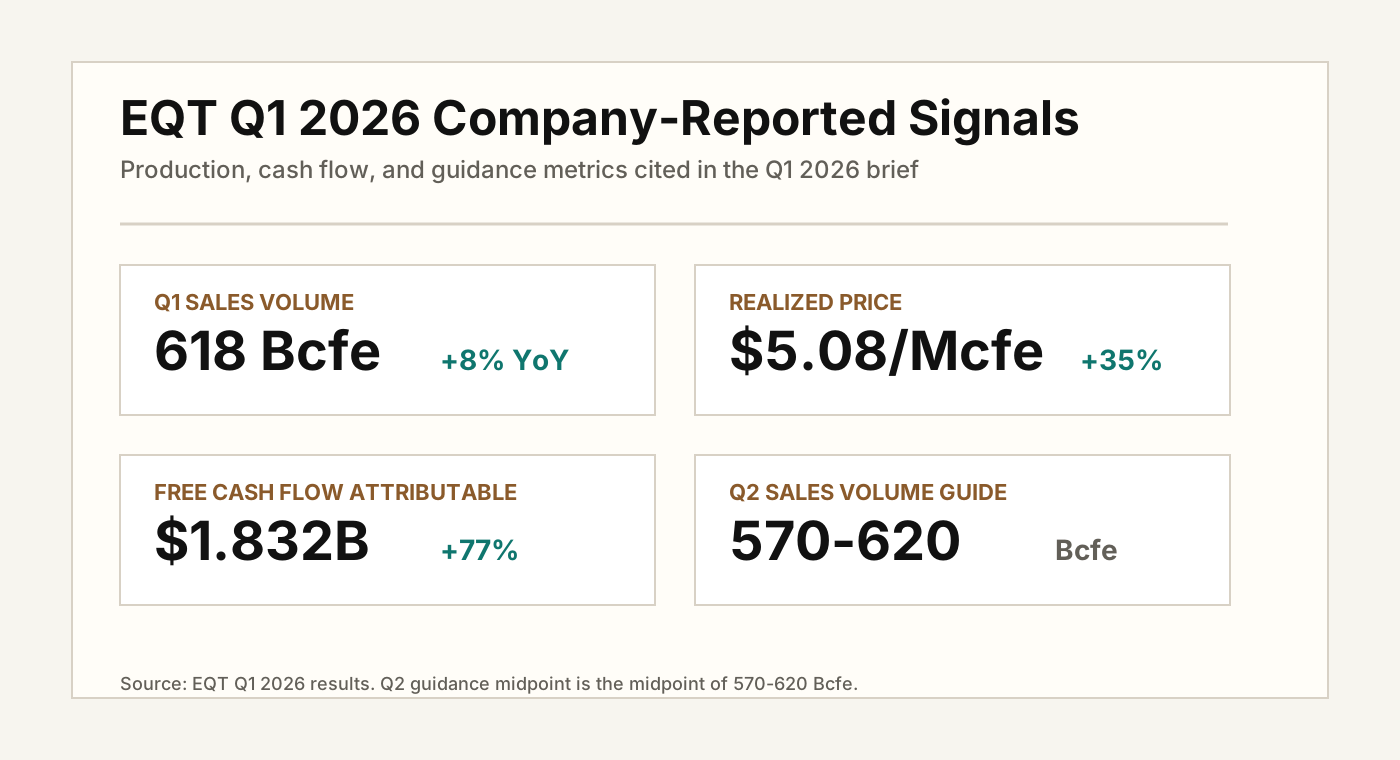
- EQT reported 618 Bcfe of Q1 2026 sales volume, up 8% year over year, and $1.832 billion of free cash flow attributable to EQT.
- Q2 guidance includes 570-620 Bcfe of sales volume and 10-15 Bcfe of strategic curtailments.
- Energy-NetWatch shows EQT-linked Pennsylvania and West Virginia state-source records with different production freshness clocks and permit signals.
EQT's first-quarter 2026 update was a strong Appalachian gas quarter: higher sales volumes, stronger realized pricing, record free cash flow, and a clear signal that Q2 volumes will be managed around shoulder-season gas prices.
For Energy-NetWatch, the useful follow-up is not a broad company-production comparison. The better read is source-level: where Pennsylvania and West Virginia public records show EQT-linked gas, which counties matter, how recent the state-source records are, and what permit activity says about near-term Appalachian workflows.
EQT reported 618 Bcfe of Q1 2026 sales volume, up from 571 Bcfe a year earlier. Average realized price improved to $5.08/Mcfe, and free cash flow attributable to EQT reached $1.832 billion. The company also guided Q2 2026 sales volume to 570-620 Bcfe, including 10-15 Bcfe of planned strategic curtailments.
| EQT reported | Q1 2026 | Prior comparison | Change |
|---|---|---|---|
| Total sales volume | 618 Bcfe | 571 Bcfe | +8% |
| Average realized price | $5.08/Mcfe | $3.77/Mcfe | +35% |
| Net cash from operating activities | $3.055B | $1.741B | +75% |
| Free cash flow | $1.945B | $1.151B | +69% |
| Free cash flow attributable to EQT | $1.832B | $1.036B | +77% |
| Total debt at quarter-end | $6.0B | $7.8B at 2025 year-end | -23% |
EQT Q1 2026 Earnings and Production Read
The quarter was not just a higher-price story. EQT said sales volumes came in above guidance because of strong well performance, system pressure optimization, and execution during Winter Storm Fern. Capital expenditures were $608 million, below guidance, and total per-unit operating costs were $1.09/Mcfe.
That combination matters for an Appalachian gas operator. Higher realized pricing helps any gas producer, but the cleaner read is that EQT grew volumes, protected margins, reduced debt, and still kept a clear curtailment lever for Q2. The balance-sheet signal also improved during the quarter: EQT said Fitch upgraded the company to BBB after the debt reduction.
The Q2 guide is important. EQT expects 570-620 Bcfe of sales volume in Q2, including 10-15 Bcfe of strategic curtailments. Management described those curtailments as a way to keep gas in the ground during weaker seasonal demand and bring volumes back when demand improves. For an operator with a large Appalachian inventory, that is a portfolio-management signal, not just a production headline.
PA and WV State-Source Signals
The Energy-NetWatch snapshot for this brief uses matched EQT state-source aliases including EQT ARO LLC, EQT CHAP LLC, EQT PROD CO, and EQT PRODUCTION COMPANY.
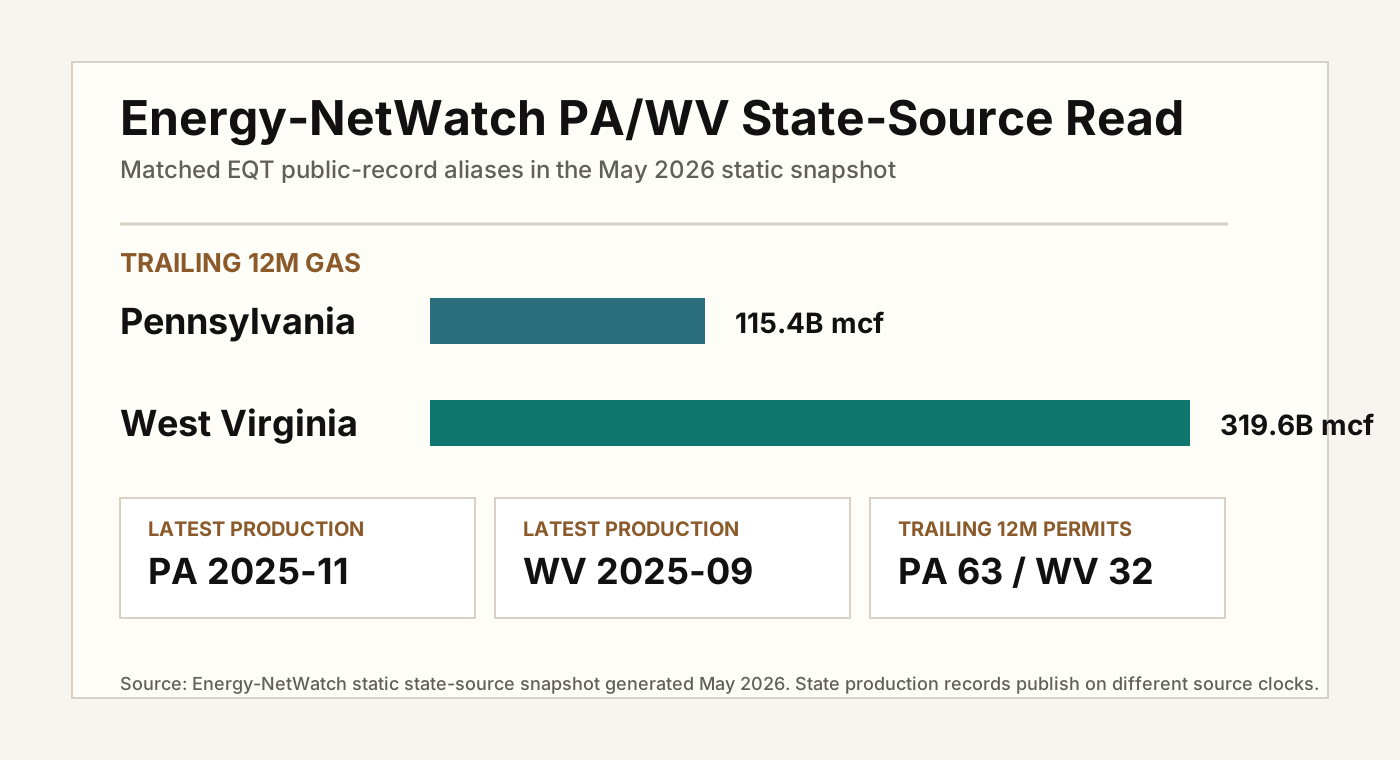
Those records show a gas-weighted Appalachian view across Pennsylvania and West Virginia. The two states are both important, but they do not publish on the same clock. In this public snapshot, Pennsylvania production records are current through November 2025, while West Virginia production records are current through September 2025.
| Energy-NetWatch matched state-source snapshot | Pennsylvania | West Virginia |
|---|---|---|
| Latest production month | 2025-11 | 2025-09 |
| Trailing 12M gas | 115.4B mcf | 319.6B mcf |
| Trailing 12M oil | 0 bbl | 815K bbl |
| Total wells in matched snapshot | 1,993 | 1,137 |
| Producing wells in matched snapshot | 1,775 | 1,137 |
| Trailing 12M permits | 63 | 32 |
| Latest permit issue date | 2025-11-12 | 2025-12-01 |
The county read-through is also useful. The top public-safe production counties in this snapshot include Greene, PA, Wetzel, WV, Marshall, WV, Lycoming, PA, Westmoreland, PA, and Washington, PA. That gives a practical map for following EQT-linked activity after earnings: Greene and Washington for southwest Pennsylvania context; Wetzel and Marshall for West Virginia gas; Lycoming and Westmoreland for additional Pennsylvania production signal.
Why The Timing Matters
Earnings releases move on the company calendar. State-source production records move on regulator calendars. That difference is the point of the Energy-NetWatch read.
EQT's Q1 2026 reported sales volume tells investors what the company delivered during the quarter. Pennsylvania and West Virginia public records tell analysts where source-level records are visible, how recently each state has published, and which operator aliases, counties, wells, and permits support follow-up work.
That is especially important for EQT because recent company materials also reference acquired upstream and midstream assets from Olympus Energy, Hyperion Midstream, and Bow & Arrow Land. Acquisition history can leave public records under legacy or state-specific names before every record collapses cleanly into a parent-company view. Energy-NetWatch treats that as an operator identity problem: the app keeps the parent-company story connected to state-source names, aliases, and source freshness.
Analyst Takeaway
EQT's Q1 update was a cash-flow and control story. Sales volume increased 8% year over year, realized pricing improved, free cash flow attributable to EQT rose to $1.832 billion, and net debt fell sharply from year-end 2025. The company also made the Q2 setup clear: volumes are expected to step down from Q1 levels, partly because EQT plans to curtail 10-15 Bcfe into a softer seasonal gas window.
The Energy-NetWatch read-through is concentrated in Appalachian source records. Pennsylvania and West Virginia show the relevant public-record base, but the two states have different production lags and different permit-record quality. That makes EQT a good example of why operator intelligence needs more than a ticker, a quarterly release, and one production number.
For teams watching Appalachian gas, the follow-up workflow is straightforward: monitor Pennsylvania and West Virginia production freshness, track EQT-linked permit activity, watch core counties such as Greene, Wetzel, Marshall, Lycoming, Westmoreland, and Washington, and keep operator aliases current as acquisitions and state-source names change.
For current records, well histories, maps, exports, alerts, and API access, the public brief is the starting point. Request Energy-NetWatch access to review current Appalachian operator and state-source data.
Frequently Asked Questions
What were EQT's Q1 2026 earnings highlights?
EQT reported 618 Bcfe of Q1 2026 sales volume, up from 571 Bcfe a year earlier. The company also reported $3.055 billion of net cash from operating activities and $1.832 billion of free cash flow attributable to EQT.
Why did EQT guide to lower Q2 2026 volumes?
EQT guided Q2 2026 sales volume to 570-620 Bcfe, including 10-15 Bcfe of strategic curtailments. Management framed the curtailments as a way to hold gas back during weaker shoulder-season demand and bring volumes forward when demand improves.
Where does Energy-NetWatch show EQT-linked public records?
This Energy-NetWatch snapshot shows EQT-linked public-record context in Pennsylvania and West Virginia, using matched state-source aliases including EQT ARO LLC, EQT CHAP LLC, EQT PROD CO, and EQT PRODUCTION COMPANY.
Why are Pennsylvania and West Virginia production months different?
State-source production records publish on regulator-specific schedules. In this public Energy-NetWatch snapshot, Pennsylvania production records are current through November 2025, while West Virginia production records are current through September 2025. That lag does not make the data weak; it tells users which source clock they are reading.
Is the Energy-NetWatch snapshot the same as EQT's reported production?
No. EQT's reported production is a company-reported quarterly metric. Energy-NetWatch state-source snapshots are normalized public records from covered state sources. They are used for operator identity, state, county, permit, well-level, production-month, and source-freshness follow-up.
Sources
- EQT first-quarter 2026 results
- EQT Q1 2026 earnings call transcript
- Energy-NetWatch static state-source snapshot, generated May 2026
Data notes
Energy-NetWatch EQT figures are matched public state-source snapshots generated in May 2026. They are rounded and used for source-level monitoring, not a company-reported net production reconciliation.
Recommended next reads
How to Track Drilling Permits by Operator Before Production Shows Up (2026)
Learn how to track drilling permits by operator, connect permits to later production signals, and avoid common state-source mistakes.
Why Oil and Gas Data Is Hard to Normalize Across States (2026)
See why oil and gas data normalization is difficult across states, source schemas, identifiers, reporting cadence, permits, and production.
Public vs Paid Oil and Gas Data: When State Portals Are Enough (2026)
Compare public vs paid oil and gas data, including state portals, normalized workflows, app access, exports, maps, and public samples.
How to Access Free Oil & Gas Production Data Across 26 States (2026 Guide)
Learn where free oil and gas production data comes from, why state records are fragmented, and how EnergyNetWatch tracks 26 states.
Related EnergyNetWatch pages
Need current records behind this analysis?
Request access for current source refreshes, unmasked well histories, maps, exports, alerts, DCA, economics, and operator workflows.
Request current data access