New Mexico Oil and Gas Production Data: OCD Records, Permits & Spuds
New Mexico OCD production data guide covering wells, operators, counties, permits, reported spuds, source dates, and current table access.
By Johnathan · Reviewed by EnergyNetWatch Research · Evergreen guide · Content updated 2026-09-18
Looking for New Mexico oil and gas production data? Start with the official OCD Statistics page for filed production reports, or the OCD public data directory for downloadable records. EnergyNetWatch provides a separate API workflow and a labeled modeled production sample; neither should be mistaken for an official statewide total.
Production measures volumes over a reporting period. Permits record drilling authorization or intent. Reported spuds record a drilling start. Choose the record that answers your question before comparing operators or counties.
Where To Find New Mexico OCD Production Data
| Your question | Start here |
|---|---|
| How much oil or gas was reported statewide? | OCD Statistics: statewide monthly production summaries |
| What was reported for a county or operator? | OCD Statistics: county monthly reports and C-115 operator reports |
| Where can I download source records? | OCD public data directory and its dataset descriptions |
OCD's statistics page states a 45-day lag for C-115 reported production and nightly updates, with some reports on a different schedule. Check the individual report's period and update note. Those source dates are separate from the EnergyNetWatch dates below.
Check the Available New Mexico Production Month
Verified September 18, 2026: an EnergyNetWatch API request for New Mexico returned June 2026 for the screened modeled-production month and July 2026 for the newest well-card snapshot month.
| API result | Returned month | What it tells you |
|---|---|---|
| Modeled production screen | June 2026 | Latest nonzero modeled month passing the endpoint's screening rule |
| Newest well-card snapshot | July 2026 | Latest month represented by any evaluated well-card snapshot |
Use June for the modeled-series boundary in this example—not July simply because a well card has a later date. Neither value says when OCD published a report or proves every New Mexico well is complete. This is a dated API check, not an automatically updating display.
Use This New Mexico Production Check Through the API
This request checks month availability; it does not download production volumes. It costs 2 API units per request under the published unit schedule. At the $50 / 10,000-unit rate, that is $0.01 of prepaid balance. An active API key with wells:read access is required.
Set your key securely in ENERGYNETWATCH_API_KEY, then run:
curl --fail-with-body --get \
  'https://api.energynetwatch.com/api/public/production/latest-month' \
  --data-urlencode 'state=NM' \
  -H "X-API-Key: ${ENERGYNETWATCH_API_KEY}"
Selected fields from the actual September 18 response; other fields are omitted:
{
  "success": true,
  "data": {
    "stateScope": "NM",
    "latestCompleteMonth": "2026-06-01",
    "latestWellExplorerMonth": "2026-07-01"
  }
}
Save these dates with your analysis so a later snapshot does not silently change the period you compared. The endpoint's monthBasis also explains its screen: the newest nonzero modeled month must reach at least 60% of the prior six-month average, otherwise it returns the prior nonzero month. That is a screening rule, not regulatory certification of completeness.
For a specific well's volumes, the separate well-production API accepts a real API identifier and state=NM. Supply start and/or end for modeled monthly history; omitting dates requests the latest well-card snapshot instead. Review the returned source, coverage and empty-result fields before using the values. That separate call has its own unit cost; the two-unit check above is not a bulk export or a promise of complete well histories.
How EnergyNetWatch Presents New Mexico Oil and Gas Production Data
The New Mexico data sample is a retained modeled series, not an official OCD statewide production total. It illustrates monthly structure and units. County, operator and masked-well examples are selected context, not a complete population.
Retained New Mexico Production Example
Correction — September 18, 2026: the table retains the January–June series reviewed September 6 and published in the Data Explorer September 12. It replaces the older sample and incorrect gas-unit label previously used here. The API check above is new verification of available months; it does not independently validate these modeled volumes.
| Month | Oil (million bbl) | Gas (million Mcf) |
|---|---|---|
| 2026-01 | 65 | 353 |
| 2026-02 | 64 | 335 |
| 2026-03 | 70 | 367 |
| 2026-04 | 69 | 353 |
| 2026-05 | 72 | 367 |
| 2026-06 | 69 | 360 |
Gas is million Mcf, not billion Mcf; one Mcf is 1,000 cubic feet. Use official OCD reports when you need filed totals. Check New Mexico coverage before purchasing for a particular dataset.
Key New Mexico Counties To Understand
Lea County
Lea is a core Delaware Basin county. Keep production-volume analysis separate from the permit and reported-spud records in the Lea County activity page.
Eddy County
Eddy is another starting point for New Mexico Permian research. The Eddy County activity page provides drilling-record context, not a county production total.
San Juan County
San Juan adds a gas-weighted San Juan Basin perspective. Do not assume an oil-weighted Delaware Basin comparison describes this county's wells.
Rio Arriba County
Rio Arriba adds legacy-basin context. Define the county, operator population and reporting period before interpreting a statewide trend as a local result.
New Mexico Source Stack: Production, Permits, And Reported Spuds
The historical February 16–May 15, 2026 review counted 694 permit records, 87 independent reported spud records, and 38 operator labels with permit activity. Its latest permit was dated May 15 and latest reported spud May 6. These are separate stage counts—not production volumes, current September activity, or proof that a rig remains on location.
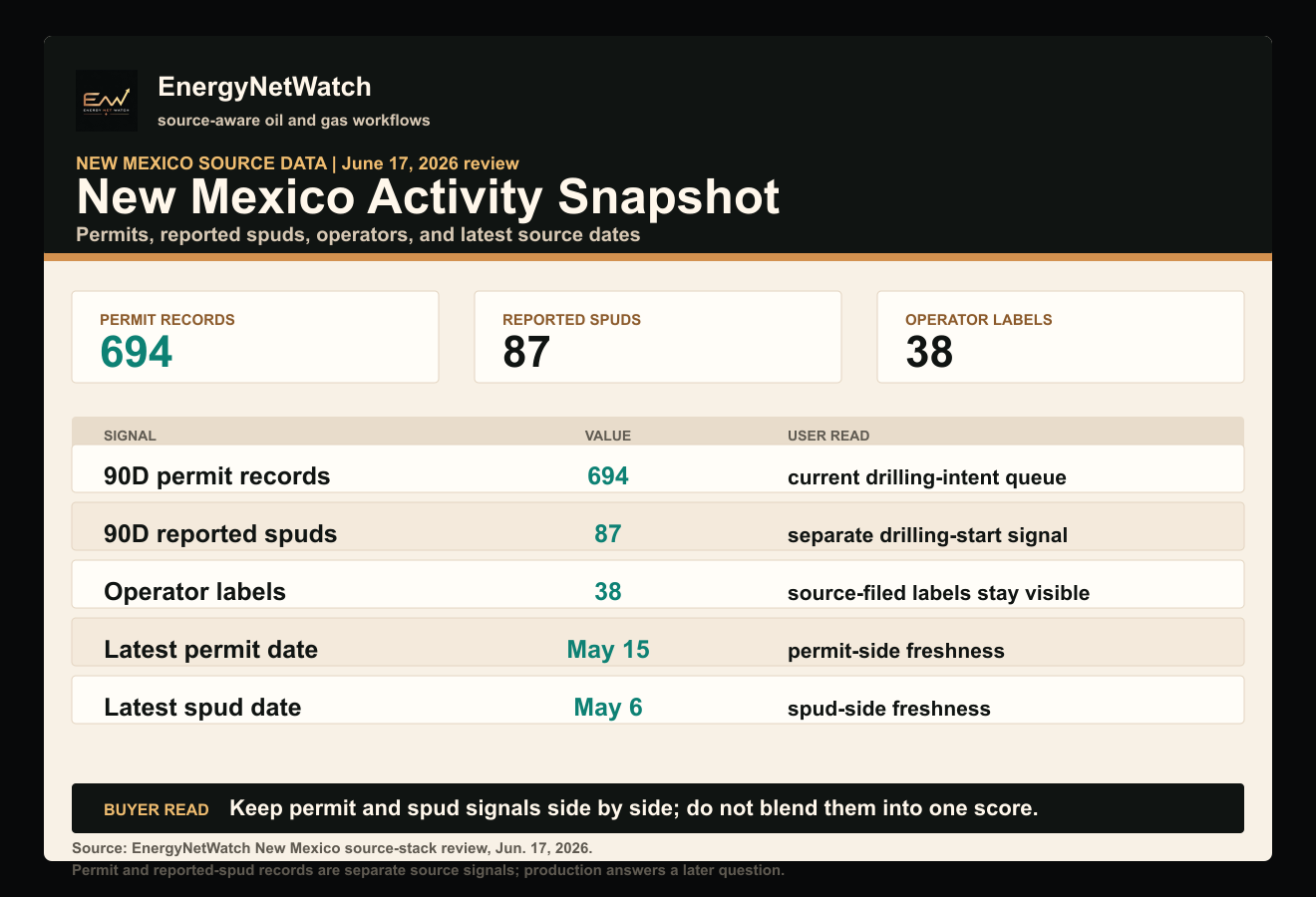
Historical permit/spud snapshot; retained for context, not refreshed by this page edit. Use the New Mexico watchlist for the maintained activity page and its stated source dates.
How New Mexico Oil and Gas Data Differs From Texas
Texas lease-level production and New Mexico OCD records need different joins and source checks. Match the reporting period, units, identifiers and record grain before comparing operators across the Delaware Basin. See the Texas production guide and production, permit and spud date guide.
Public Lag, Masking, and Rounding
The public sample uses rounded modeled values and selected or masked examples. Its review date is not a guarantee of source completeness. Keep the report period, source-publication date where known, and EnergyNetWatch review date separate. Do not infer a missing month is zero production.
What App Access Adds for New Mexico Data
Use API access for supported programmatic requests and repeatable checks like the example above. Use the separate paid app for supported map, search and export workflows. Dataset availability and production-history depth vary; neither purchase establishes that every New Mexico record or month is present. Review workflows and coverage before choosing. For a specific delivery requirement, request a scoped data review.
Frequently Asked Questions
Is New Mexico oil and gas production data public?
Yes. Start with OCD Statistics and the OCD public data directory for official reports and downloadable records. EnergyNetWatch's modeled sample is a separate presentation, not an official state total.
Why are there two latest production months in the API example?
The endpoint checks two different datasets. The screened modeled month was June 2026 and the newest well-card snapshot month was July when checked September 18. A later snapshot does not mean all modeled monthly histories are complete through that date.
Are the public New Mexico numbers real?
The table is a retained modeled EnergyNetWatch series with a stated review date. It is not independently reconciled official statewide production. The API response excerpt is from an actual successful request, but reports month availability rather than validating those volumes.
What should I use for current New Mexico records?
Use official OCD reports for filed production. For EnergyNetWatch queries, check supported coverage and returned source dates before using the API or app. The dated examples on this page are not live feeds.
Sources
- New Mexico Oil Conservation Division, OCD Statistics and public data directory — official records and report schedules.
- EnergyNetWatch API reference and API unit pricing — request parameters and access costs.
- EIA natural gas measurement units.
- Oil Conservation Division Data — New Mexico Water Data and RBDMS oil and gas data overview — additional source context.
Data notes
September 18 content correction aligns the modeled January–June 2026 series with the retained September 6 evidence. Gas is million Mcf. The separate February–May permit/spud snapshot remains historical; this edit is not a new ingestion.
Recommended next pages
New Mexico Drilling Activity Snapshot: Permits and Reported Spuds by Operator
New Mexico operators ranked by trailing 90-day permit records and independent reported spud records from EnergyNetWatch app data.
RRC Production Data Query | Texas Oil & Gas by Lease
Look up Texas RRC production data by lease, operator, and month. Lease grain, not well.
Oil And Gas Data Freshness: Why Permits, Spuds, And Production Dates Differ (2026)
Oil and gas data freshness guide explaining why permits, reported spuds, and production records have different source dates.
Oil and Gas Data API for Public Energy Data Workflows
Learn how to evaluate oil and gas data APIs, source context, coverage, fields, and delivery choices before comparing commercial integration options.
Related EnergyNetWatch pages
Query the current records with an API key
Start with $50 in prepaid API credits and create the key yourself. Use request access only when the job needs a custom report, delivery scope, or team agreement.