Chevron Q1 2026 Brief: Hess, Bakken, Permian, and State-Record Production Signals
Chevron beat adjusted earnings expectations in Q1 2026, while Hess, Bakken, Gulf of America, and Permian activity drove the production story.
By Johnathan · Reviewed by EnergyNetWatch Research · Last updated 2026-05-08
Key Takeaways
- Chevron reported 2.024 MMBOE/d of U.S. upstream production in Q1 2026, up 24% year over year.
- The production bridge included Guyana, Bakken, Gulf of America, and Permian contributions.
- Energy-NetWatch adds state-record context across New Mexico, Texas, North Dakota, Colorado, and California.
Chevron's first-quarter results beat adjusted earnings expectations, but the more important operating story was production scale. Hess is now visible in Chevron's reported base, Gulf of America projects are contributing, and Permian growth remains a core Lower 48 driver.
For Energy-NetWatch, the follow-up question is where that production story shows up in public state records. The strongest read-through in this brief is tied to New Mexico oil and gas data, Texas production and permit records, and the North Dakota Bakken sample in the public data explorer.
Chevron reported $2.2 billion in Q1 2026 earnings, down from $3.5 billion a year earlier. Adjusted earnings were $2.8 billion, or $1.41 per share, ahead of consensus estimates cited by Reuters. Cash flow from operations was $2.5 billion, while cash flow from operations excluding working capital was $7.1 billion. Chevron also returned $6.0 billion to shareholders through $3.5 billion of dividends and $2.5 billion of share repurchases.
The production story was stronger than the earnings comparison. Worldwide production increased 15% year over year to 3.858 MMBOE/d, while U.S. upstream production increased 24% to 2.024 MMBOE/d.
| Chevron reported | Q1 2026 | Q1 2025 | Change |
|---|---|---|---|
| Earnings | $2.2B | $3.5B | -37% |
| Adjusted earnings | $2.8B | $3.8B | -27% |
| CFFO ex-working capital | $7.1B | $7.6B | -7% |
| Worldwide production | 3.858 MMBOE/d | 3.353 MMBOE/d | +15% |
| U.S. upstream production | 2.024 MMBOE/d | 1.636 MMBOE/d | +24% |
| U.S. liquids | 1.461 MMBbl/d | 1.159 MMBbl/d | +26% |
| U.S. natural gas | 3.380 Bcf/d | 2.859 Bcf/d | +18% |
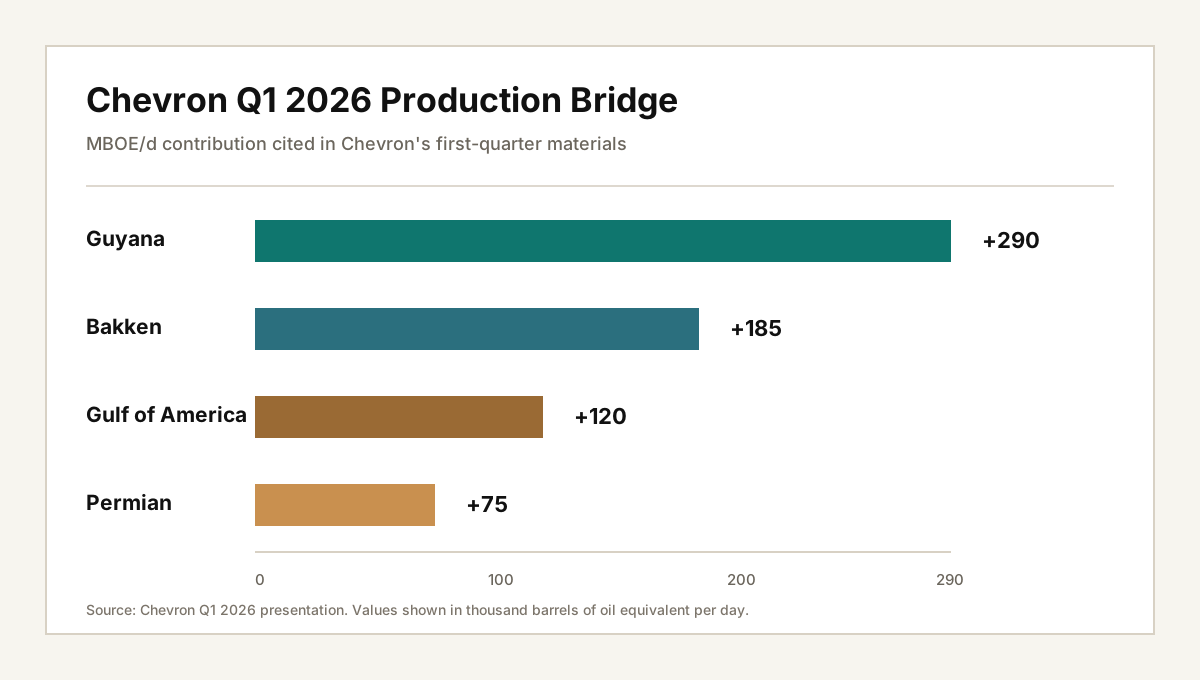
Chevron's Q1 production bridge points to four drivers: Hess, Gulf of America, Permian, and base portfolio movement. The Hess contribution was split across Guyana and Bakken, while Gulf of America and Permian growth remained important pieces of the U.S. story.
The quarter was stronger operationally than financially. Chevron's production base expanded meaningfully after Hess and continued Permian/Gulf of America activity, but reported earnings were lower year over year as downstream results weakened and timing effects pressured the quarter. Chevron also guided to 100 to 150 MBOE/d of expected upstream downtime in Q2, making follow-through in the next quarter an important watch item.
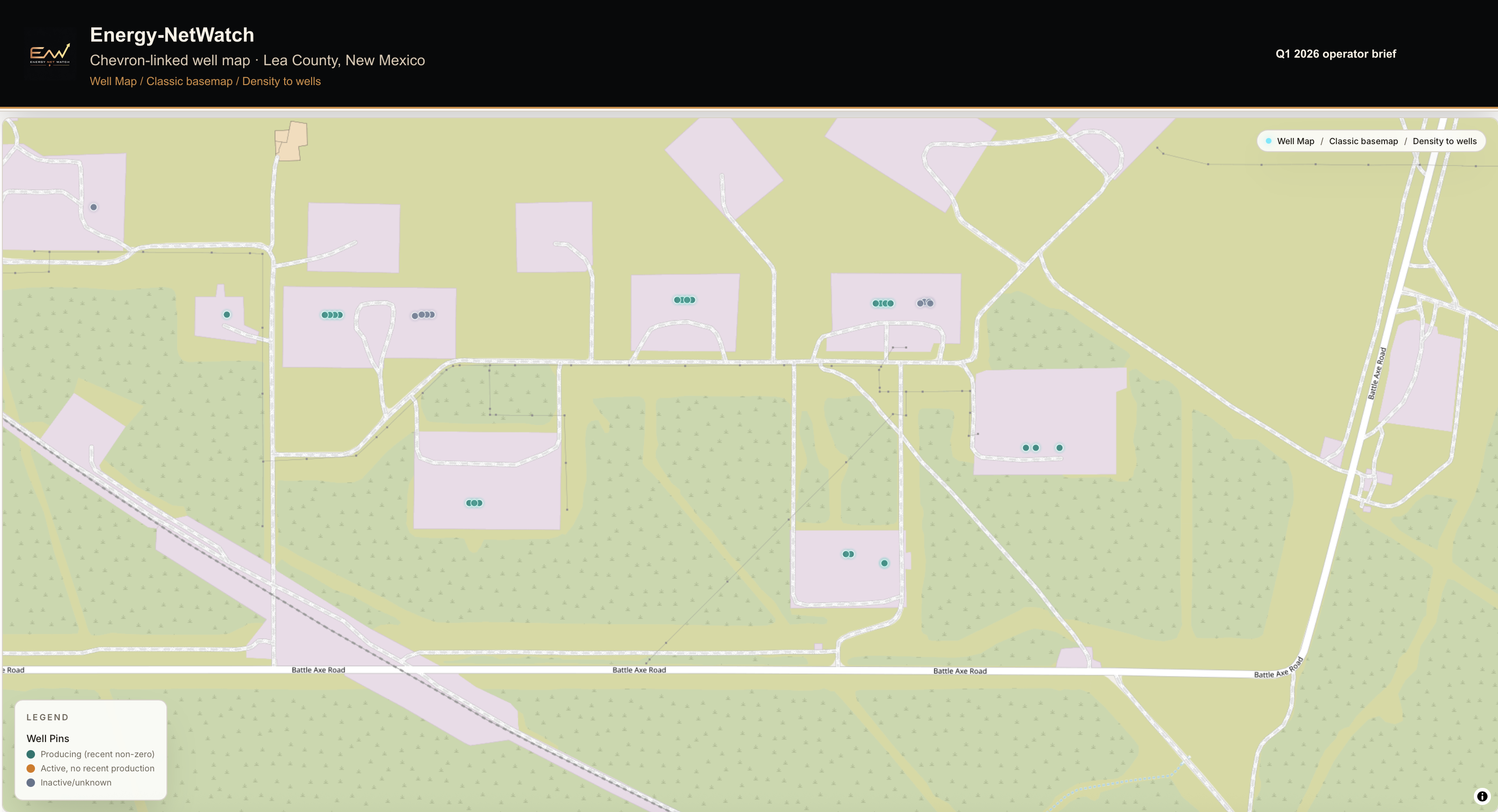
The Energy-NetWatch state-source view adds a different layer: where Chevron-linked activity appears in public records across key onshore states. The map below shows a Chevron-linked well view in Lea County, New Mexico, one of the core New Mexico counties for Permian activity.
Energy-NetWatch Read
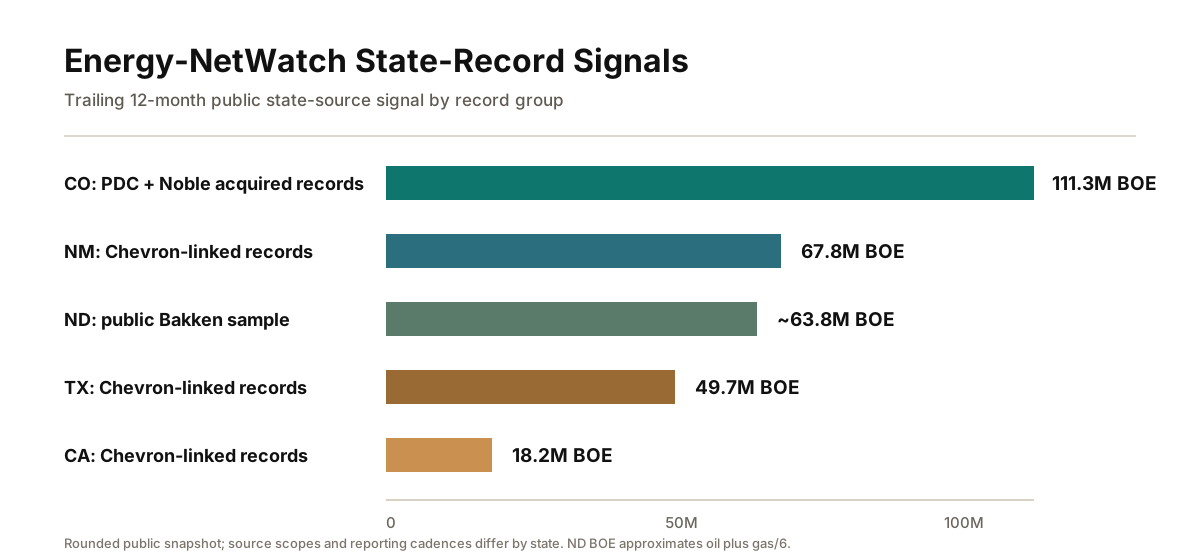
In the current Energy-NetWatch snapshot, Chevron-linked public records show the strongest onshore production signals in New Mexico, Texas, Colorado, California, and North Dakota.
| Energy-NetWatch state-record view | Current signal |
|---|---|
| New Mexico | Chevron-linked records show roughly 67.8M BOE over the trailing 12 months, led by Permian exposure. |
| Texas | Chevron-linked records show roughly 49.7M BOE over the trailing 12 months, with permit, spud, completion, and facility context. |
| Colorado | PDC and Noble records remain important to Chevron's acquired DJ Basin footprint, with roughly 111.3M BOE over the trailing 12 months across those acquired record groups. |
| North Dakota | The public Bakken sample shows 43M bbl of oil and 125B mcf of gas in the latest rounded monthly snapshot, with Hess included in the sample operator and well context. |
| California | Chevron-linked records show roughly 18.2M BOE over the trailing 12 months, reflecting a large legacy state-record base. |
Chevron's Permian read-through remains concentrated in New Mexico and Texas. New Mexico shows the larger Chevron-linked production base in this snapshot, at roughly 67.8M BOE over the trailing 12 months. Texas adds complementary activity signals, including Chevron-linked permit and facility records.
That is why both state pages matter. The New Mexico public sample shows the Lea and Eddy County side of the Delaware Basin, while the Texas public sample adds Texas Permian production, permit, and lifecycle context.
Hess changes the production mix. Chevron's Q1 bridge showed +185 MBOE/d from the Bakken, while the larger +290 MBOE/d Guyana contribution reflects Hess's offshore position in Guyana's Stabroek Block. For Energy-NetWatch, the Bakken is the more direct public-record angle: the North Dakota sample tracks Bakken and Williston Basin activity across McKenzie, Mountrail, Williams, and Dunn counties, with Hess included in the operator context. See the North Dakota coverage page for current state-source parity.
Colorado is also relevant, but for a different reason. Chevron's acquired DJ Basin exposure still shows up through PDC and Noble records. That matters because acquisition history can remain visible in state records long after the parent-company reporting line has changed.
Analyst Takeaway
Chevron's Q1 update was a scale story more than an earnings story. Adjusted EPS beat expectations, but net income was lower year over year and downstream/timing effects made the quarter less clean. The operating base, however, is larger: U.S. upstream production increased 24% year over year, with Hess adding Bakken and Guyana exposure, Gulf of America projects adding offshore growth, and the Permian continuing to anchor the Lower 48 portfolio.
The Energy-NetWatch read-through is state-specific: New Mexico and Texas show the clearest Permian activity base, North Dakota becomes more important after Hess, Colorado captures acquired DJ Basin exposure, and California remains a meaningful legacy production market.
For teams that need current operator records, well histories, maps, exports, alerts, and API access, the public brief is the starting point. The authenticated app is the workflow layer. Request Energy-NetWatch access to review current operator and state-source data.
Frequently Asked Questions
What drove Chevron's Q1 2026 production growth?
Chevron's Q1 2026 production growth was driven by Hess integration, Gulf of America project activity, Permian growth, and base portfolio movement. Chevron's production bridge cited Guyana, Bakken, Gulf of America, and Permian contributions.
How did Hess affect Chevron's Q1 2026 production?
Hess affected Chevron's Q1 production through Guyana and Bakken exposure. Chevron's Q1 materials showed +290 MBOE/d from Guyana and +185 MBOE/d from Bakken in the production bridge.
Where does Energy-NetWatch show Chevron-linked state records?
Energy-NetWatch shows Chevron-linked public-record context across New Mexico, Texas, Colorado, California, and North Dakota. The strongest onshore read-through in this brief is New Mexico and Texas for Permian activity, North Dakota for Hess/Bakken context, and Colorado for acquired PDC and Noble records.
Is the Energy-NetWatch snapshot the same as Chevron's reported production?
Not exactly. Chevron's reported production is a consolidated company metric for the quarter. Energy-NetWatch is built from normalized state-source records, which publish on regulator cadence and can trail company reporting by weeks or months. The public snapshot is rounded and intentionally lagged, while the platform uses the same source-level framework for operator, county, permit, well-level, and production follow-up as records refresh.
Sources
- Chevron first-quarter 2026 results
- Chevron first-quarter 2026 presentation
- Reuters Q1 earnings coverage
- Energy-NetWatch static state-source snapshot, generated May 2026
Data notes
Energy-NetWatch state-source figures are public-record snapshots and selected sample views, not a company-reported net production reconciliation. Values are rounded for public display.
Recommended next reads
New Mexico Oil and Gas Production Data: OCD Sources and Public Samples (2026)
Learn how New Mexico oil and gas production data works, where OCD sources fit, and how public EnergyNetWatch samples show Permian context.
Texas Oil and Gas Production Data: RRC Records and Public Samples (2026)
Understand Texas oil and gas production data, RRC reporting limits, public sample trends, and when normalized app workflows help.
How to Track Drilling Permits by Operator Before Production Shows Up (2026)
Learn how to track drilling permits by operator, connect permits to later production signals, and avoid common state-source mistakes.
Why Oil and Gas Data Is Hard to Normalize Across States (2026)
See why oil and gas data normalization is difficult across states, source schemas, identifiers, reporting cadence, permits, and production.
Related EnergyNetWatch pages
Need current records behind this analysis?
Request access for current source refreshes, unmasked well histories, maps, exports, alerts, DCA, economics, and operator workflows.
Request current data access