
Diamondback Energy Texas Drilling Permits: Q1 2026 Follow-Through
Diamondback operator intelligence brief covering Texas permit rank, reported-spud follow-through, sample well context, and T-4 infrastructure lead evidence.
By Johnathan · Reviewed by EnergyNetWatch Research · Historical report
Historical report
This page is a historical source-record snapshot tied to a specific company update or activity event. It links back into durable operator and state workflows.
Key Takeaways
- Diamondback reported 521.0 MBO/d of average oil production and 979.4 MBOE/d of total production in Q1 2026.
- Diamondback E&P LLC ranked first by trailing 90-day Texas permit count in the reviewed public snapshot.
- The main signal is permit-to-spud follow-through plus county, well, and infrastructure context.
EnergyNetWatch reviewed Diamondback Energy's Texas permit, reported-spud, sample well, and infrastructure records after the company's Q1 2026 update.
Operator Signal
| Field | Current signal |
|---|---|
| Operator | Diamondback Energy |
| Main public-record label | Diamondback E&P LLC |
| State focus | Texas |
| Main signal | First-ranked operator in the reviewed Texas 90-day permit snapshot |
| 90D permits | 159 |
| 90D reported spuds | 18 |
| 12M permits | 359 |
| Latest permit in row | Apr. 29, 2026 |
| Latest reported spud in row | Mar. 22, 2026 |
| Watchlist signal | Active permit leader; monitor reported-spud follow-through and infrastructure context |
Diamondback led the reviewed Texas permit table, but reported spuds did not rise at the same scale in the same window. That gap is the account-screening work.
At A Glance
| Field | Current signal |
|---|---|
| Q1 2026 average oil production | 521.0 MBO/d |
| Q1 2026 average total production | 979.4 MBOE/d |
| 2026 oil production guidance | 520+ MBO/d |
| 2026 total production guidance | 972+ MBOE/d |
| Q1 cash capital expenditures | $933M |
| Updated 2026 capital plan | About $3.90B |
| Midland Basin gross wells drilled | 118 |
| Midland Basin gross wells completed | 147 |
Diamondback's company update gives the operating scale. EnergyNetWatch adds the source-record follow-through: permit rows, reported spuds, a masked public well example, and a Diamondback-linked T-4 infrastructure lead.
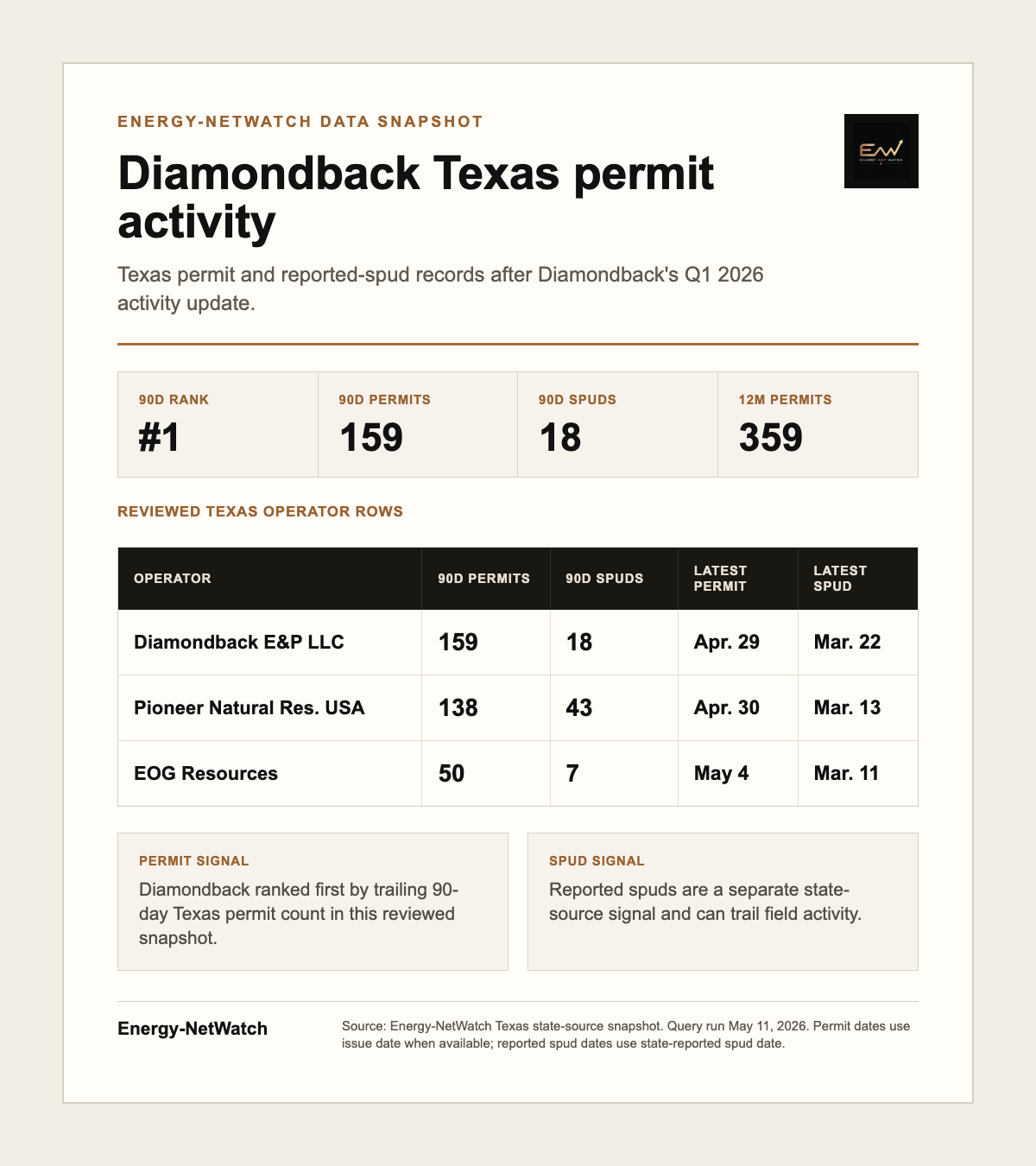
EnergyNetWatch Texas state-source snapshot. Operators are ranked by trailing 90-day permit count.
What Changed Recently
| Signal | Current signal |
|---|---|
| Texas permit rank | Diamondback E&P LLC ranked first in the reviewed 90D Texas permit snapshot. |
| Permit count | 159 permits in the reviewed 90D window. |
| Reported-spud count | 18 reported spuds in the same reviewed 90D window. |
| Company guidance | Diamondback raised 2026 production guidance and capital expectations. |
| Infrastructure lead | A Diamondback-linked Midland County gas/private T-4 row appears in the public midstream artifact. |
The main signal is permit-to-spud follow-through. A high permit count can indicate near-term planning and authorization activity, but the spud row is the later state-source check on drilling-start evidence.
Source-Record Snapshot
| Field | Current signal |
|---|---|
| Source layer | Texas drilling permits and reported spuds |
| Reviewed operator label | Diamondback E&P LLC |
| Reviewed 90D permits | 159 |
| Reviewed 90D reported spuds | 18 |
| Reviewed 12M permits | 359 |
| Full displayed Texas 90D permit pool | 1,762 permits |
| Full displayed Texas 90D reported-spud pool | 192 reported spuds |
Diamondback led the displayed Texas 90-day permit group. Pioneer had the second-highest displayed permit count and the highest displayed reported-spud count among the top rows. That distinction matters because permit count and reported-spud count answer different questions.
Public Sample Well Context
| Field | Current signal |
|---|---|
| Sample county | Reeves County, Texas |
| Operator context | Diamondback Energy |
| Public sample month | February 2026 |
| Rounded oil signal | About 18K bbl |
| Rounded gas signal | About 72K mcf |
The public sample row is masked and rounded. It is included to show the record shape: operator, county, month, oil, gas, and source timing. App access is where the full well list, identifiers, maps, production histories, exports, and saved workflows live.
Infrastructure Context
| Field | Current signal |
|---|---|
| Source | Texas RRC YTD new T-4 permits artifact |
| Operator | Diamondback E&P LLC |
| Permit number | 10765 |
| Permit type | Gas |
| Classification | Private |
| County | Midland |
| RRC YTD list last updated | Apr. 15, 2026 |
Use this as an infrastructure lead, not a full midstream project profile. The next workflow is to connect the T-4 row to route context, related assets, and any additional source documents.
This public page intentionally stops at the evidence class and one reviewed example. The current route package, related facility rows, maps, exports, alerts, and API fields belong in the EnergyNetWatch app workflow, not in a free public lead table.
Why It Matters
| User | What to check |
|---|---|
| BD and service companies | Diamondback belongs on a Texas activity watchlist because the permit count is high and concentrated enough for follow-up. |
| Analysts | The company report and state-source records should be checked together, not merged into one number. |
| Data and API buyers | The requestable table is the current operator permit/spud table with source dates, counties, maps, exports, and alerts. |
| Infrastructure teams | The T-4 lead adds a surface and pipeline context layer to the permit signal. |
The public-record signal does not say Diamondback drilled 159 wells. It says the reviewed Texas permit table shows 159 permit records for the operator label in the 90-day window, with 18 reported spuds appearing in the same window.
What To Watch Next
| Watch item | Why it matters |
|---|---|
| New Texas permits after Apr. 29 | Tests whether Diamondback remains near the top of the current permit table. |
| Reported spuds after Mar. 22 | Shows whether permitted locations are appearing as drilling starts in later source records. |
| Reeves and Midland County rows | Keeps county follow-up tied to actual source records. |
| T-4 and facility context | Adds infrastructure evidence around the operating area. |
| Peer comparison | Separates permit leaders from spud leaders in the same time window. |
What To Request
Ask for the current Diamondback Texas operator activity table: permit issue dates, reported-spud dates, county fields, sample well context, infrastructure leads, maps, exports, alerts, and API options.
Frequently Asked Questions
Is this Diamondback's total production?
No. Diamondback's production figures are company-reported. EnergyNetWatch's Texas snapshot is a state-source activity view focused on permits, reported spuds, sample well records, and infrastructure leads.
Is a permit the same thing as a drilled well?
No. Permits show authorized or planned activity. Reported spuds show drilling-start evidence once that event appears in the state record.
Why include infrastructure?
Infrastructure records can show where operator activity may need gathering, pipeline, processing, or field-support context. The Diamondback-linked T-4 row is a public-record lead for follow-up.
Sources
- Diamondback Energy Q1 2026 results release, May 4, 2026
- Diamondback Energy Q1 2026 investor presentation, May 2026
- EnergyNetWatch Texas drilling permits by operator snapshot, query run May 11, 2026.
- EnergyNetWatch Texas public data sample.
- EnergyNetWatch local Texas T-4 new-permits artifact, parsed from the RRC YTD new T-4 permits list last updated Apr. 15, 2026.
Data notes
Company-reported figures are from Diamondback Energy first-quarter results. EnergyNetWatch figures are reviewed Texas public state-source permit, reported-spud, sample well, and infrastructure records from May 2026, used for source-level monitoring and not as a company-reported production reconciliation.
Recommended next pages
Texas Drilling Permits by Operator: May 2026 Permit and Spud Activity Snapshot
Texas operators ranked by trailing 90-day drilling permits, with recent reported spuds and source freshness notes from EnergyNetWatch.
EOG Q1 2026 Brief: Liquids Guidance and TX/NM Permit-Spud Follow-Through
EOG operator intelligence brief covering Texas and New Mexico permits, reported spuds, county follow-through, and Q1 2026 activity context.
RRC Production Data Query | Texas Oil & Gas by Lease
Look up Texas RRC production data by lease, operator, and month. Lease grain, not well.
How to Track Drilling Permits by Operator Before Production Shows Up (2026)
Learn how to track drilling permits by operator, connect permits to later production signals, and avoid common state-source mistakes.
Related EnergyNetWatch pages
Want the current table behind this analysis?
Public articles use selected examples. Request access if your team needs current source refreshes, exact identifiers, maps, exports, alerts, saved workflows, or API access for this market.