
Oil and Gas Data API for Public Energy Data Workflows
Learn how to evaluate oil and gas data APIs, source context, coverage, fields, and delivery choices before comparing commercial integration options.
By Johnathan · Reviewed by EnergyNetWatch Research · Evergreen guide · Content updated 2026-09-18
Key Takeaways
- API buyers usually need recurring access to operator, permit, well, production, infrastructure, and source freshness records.
- Standard API credits are self-service; supported endpoints, account entitlements, dataset coverage, and usage limits still apply.
- Downstream systems should preserve record type, source date, coverage context, and caveats instead of flattening every record into one activity signal.
An oil and gas data API is useful only if the records keep their source context.
The core question is simple: can my team get operator, permit, well, production, and infrastructure records into our own workflow without rebuilding state-source joins every month?
The hard part is not a JSON response by itself. The hard part is knowing which source record the response came from, how current that source is, what state coverage supports the field, and whether the record is safe to compare with another table.
EnergyNetWatch offers self-service prepaid API credits for supported endpoints. Start with $50 for 10,000 API units; once payment is processed and API access is active, create a key in Settings → API Access. Custom datasets, licensing, and integration help are separate conversations.
This Insight is the educational guide to evaluating those records and integration choices. If you are comparing endpoint coverage, pricing, access, and implementation details, use the commercial oil and gas data API page and the public API reference.
How To Evaluate Oil And Gas Data API Use Cases
The strongest API buyers are usually not looking for a public lookup toy. They are trying to remove repeated manual work from an existing business process.
Common API use cases include:
| Buyer workflow | API job |
|---|---|
| Internal dashboard | Pull operator, permit, well, production, and freshness records into an existing reporting environment |
| Account targeting | Build operator or county lists from recent permits, production scale, infrastructure records, or state-source activity |
| Data enrichment | Add operator, API number, county, status, production, or permit fields to CRM or internal records |
| Monitoring | Check source freshness, latest production month, new permits, or operator activity changes |
| AI or analyst workflow | Provide source-aware context to an internal assistant, model, or research workflow |
| Partner integration | Feed selected EnergyNetWatch records into a customer portal, reporting workflow, or private application |
The API is most valuable when the downstream system preserves record type and source basis. A permit endpoint, a production endpoint, and a well endpoint should not be collapsed into one generic activity number without explaining what each record proves.
What The EnergyNetWatch API Can Support
The public EnergyNetWatch API reference describes authentication, usage, and the supported endpoint family. API access is scoped by account, entitlement, dataset, and use case.
Current public reference areas include:
| API area | Example use |
|---|---|
| Health and authentication | Confirm a key is active and entitled before a job runs |
| Operators | Search and page operator records; fetch selected operator profiles |
| Operator summaries | Pull production or permit summaries where coverage supports the response |
| Permits | Search permits and rank top permit operators |
| Wells | Search wells and fetch a well profile by API number |
| Production | Fetch supported well production history or latest known production month |
| Facility permits | Preview infrastructure/facility records with source caveats |
| OpenAPI | Use the machine-readable contract for authenticated integrations |
That structure gives buyers a practical starting point: which records can be requested, which source context comes back, and where the app still needs a human-reviewed workflow before a public claim is made.
Fields Buyers Usually Need
Different buyers ask for different fields, but most API conversations quickly return to the same practical objects.
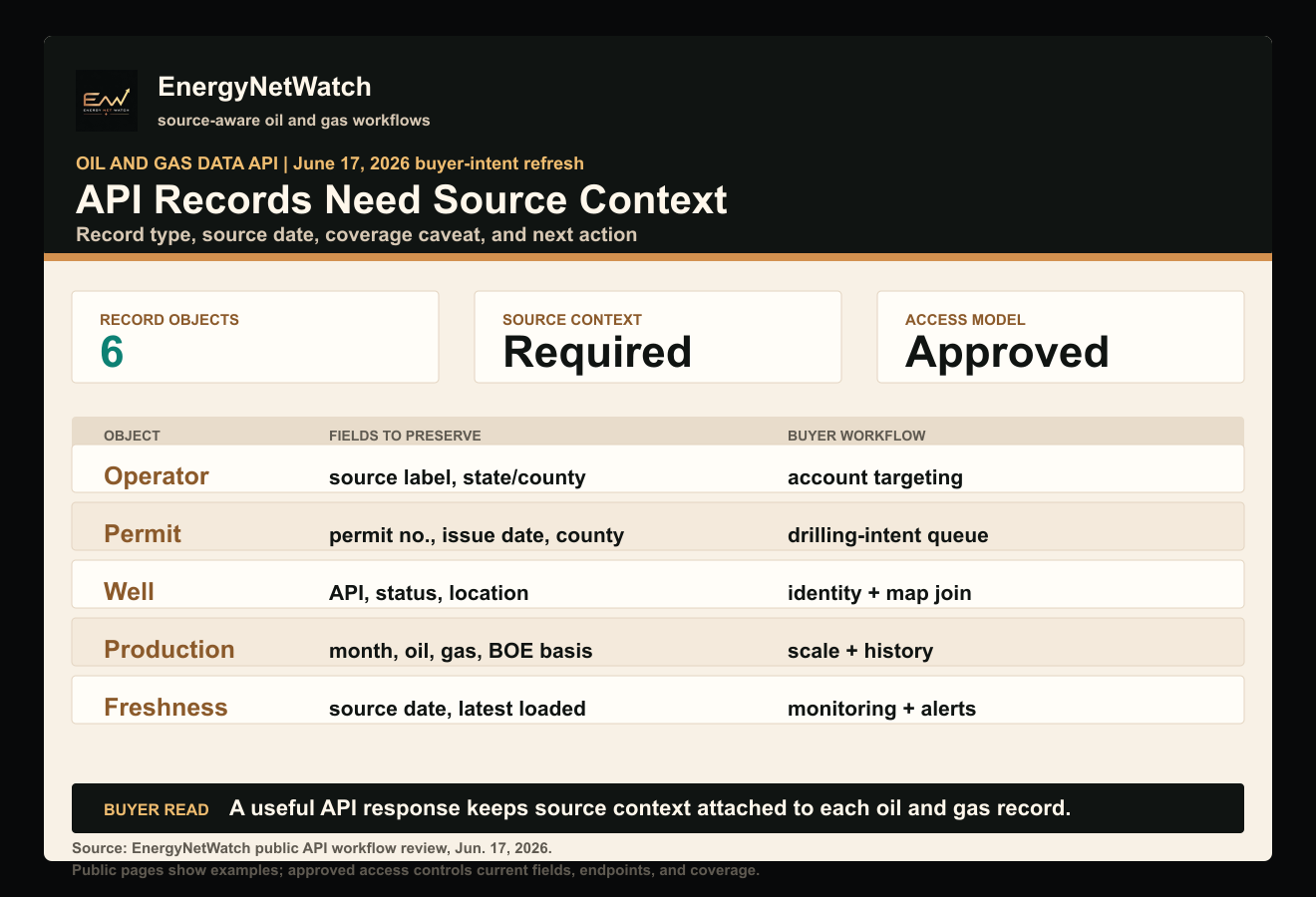
EnergyNetWatch API workflow sample. The useful API response keeps record type, source date, coverage, caveat, and buyer workflow attached to the row.
| Object | Common fields buyers ask for |
|---|---|
| Operator | operator name, source label, canonical or reviewed label context, state, county, activity summaries |
| Permit | permit number, issue date, operator, county, well name, API number where available, source date, permit type |
| Well | API number, well name, operator, county, state, status, location context, production availability |
| Production | production month, oil, gas, BOE method, source basis, latest nonzero month, reporting lag |
| Infrastructure | facility or permit source, operator, county, source-effective date, record type, lead quality context |
| Freshness | source, latest loaded date, latest production month, lag, automation or review status |
The important part is that those fields should not be interpreted without their source basis. For example, Texas production reporting is not a same-week activity signal. A May permit record, an April reported-spud record, and a March production record can all be current for their own source clocks.
API Versus Public State Portals
State portals are still the source of truth. They are essential for verification, audit, and source documentation.
The API becomes useful when the work repeats.
| Public state portal | EnergyNetWatch API workflow |
|---|---|
| Good for checking a source record manually | Good for recurring pulls into internal systems |
| Each state uses its own schema, search behavior, and naming conventions | API responses can normalize common objects while keeping source context visible |
| Exports may be limited, manual, or split across systems | Prepaid API access supports structured server-side integration |
| Source records need interpretation before they become buyer workflows | Responses can carry source dates, coverage, and caveats for downstream use |
For one-off research, a public portal may be enough. For repeatable account targeting, monitoring, mapping, reporting, or AI workflows, API access can reduce manual rebuilds.
API Versus Screenshots Or CSV Exports
Screenshots and CSV exports still have a place.
A screenshot is useful when a team needs to show a map view, a workflow surface, or a reviewed table in a meeting. A CSV export is useful when an analyst needs a one-time dataset for review.
An API is useful when the data needs to move repeatedly.
| Delivery method | Best fit |
|---|---|
| Screenshot | Proving what a workflow or map looked like at a point in time |
| CSV export | One-time analyst review or spreadsheet handoff |
| Saved workflow | Repeating the same EnergyNetWatch review inside the app |
| API endpoint | Feeding selected records into another system on a recurring basis |
The right answer is often a combination: use the app to define the reviewed workflow, export or screenshot for human validation, then use the API where a system needs repeatable access.
Source Dates And Coverage Matter
Oil and gas data does not update on one universal clock.
Production, permits, reported spuds, well records, facility permits, and state-source metadata can each have a different latest available date. Coverage also varies by state. Some states support deeper production workflows, some support stronger permit workflows, and some require more caveats before a record should be used for ranking or automation.
That is why an oil and gas data API should answer more than "what is the value?"
It should also help answer:
- what record type is this?
- which state/source produced it?
- what date does the record support?
- is the record current, lagged, revised, or selected?
- what coverage caveat should travel with the response?
- can this field be compared across states or only inside one source context?
EnergyNetWatch's public coverage table and methodology pages are designed to make those boundaries visible before buyers request app or API access.
Example API Workflow
A practical operator activity integration might look like this:
operator list -> permit activity -> production scale -> source freshness -> export/API handoff
For a BD team, that may produce account lists by county and operator. For a data team, it may populate an internal warehouse. For an analyst, it may keep a dashboard current without re-downloading public state files.
The API does not remove the need for source judgment. It makes the repeatable parts of the workflow easier to automate after the source basis is known.
Request The Right API Sample
The strongest API request is specific.
Instead of asking for "oil and gas data," ask for the record stack that matches the workflow:
| Workflow need | Better API request |
|---|---|
| Operator targeting | Request API access for operator activity records |
| Current drilling activity | Request a permit and reported-spud API sample |
| Production analysis | Request production history and latest-month fields |
| County screening | Request county-level operator, permit, and production context |
| Internal freshness monitor | Request source-date freshness and coverage metadata |
| Infrastructure targeting | Request facility permit and infrastructure lead records |
Ready to compare endpoint coverage, pricing, or integration fit? Start with the commercial oil and gas data API page. This guide remains the source-context and evaluation reference.
For standard access, create an account and open API Access. Review API pricing and coverage first if you need to confirm fit. Use the custom request path below only when you need help beyond the standard offering.
Next Useful Pages
- Commercial oil and gas data API for endpoint coverage, pricing, API credits, and the purchase path.
- Developers / API for the public reference, endpoint families, and OpenAPI contract.
- Coverage for state-by-state permit and production parity before an integration scope is set.
- Methodology for the source-handling rules that should travel with API fields.
- Texas Oil and Gas Permit Activity Watchlist and New Mexico Permit and County Activity Watchlist for public workflow examples before an API request is scoped.
- Request access when the team needs an approved sample tied to a specific operator, permit, production, or infrastructure workflow.
Frequently Asked Questions
Does EnergyNetWatch offer an oil and gas data API?
Yes. Standard API credits are self-service. Endpoint scope, dataset availability, account entitlements, and usage limits still apply. Custom data delivery and licensing may require review.
What oil and gas records can the API support?
The public API reference describes endpoint families for health checks, operators, permits, wells, production, facility permits, latest production month, top permit operators, and OpenAPI documentation. Coverage varies by state and dataset.
Is API access the same as the public website?
No. Public pages show selected summaries, methodology, sample records, and coverage context. API access is for authenticated integrations that need structured records in another system.
Should I use screenshots, CSV exports, or the API?
Use screenshots to validate a workflow visually, CSV exports for one-time analysis, and API access for recurring system-to-system data movement.
How should API responses handle stale or lagged source data?
Downstream systems should retain source dates, latest loaded dates, production months, coverage caveats, and record type. A lagged production record can be valid for production analysis while still being inappropriate as a current activity signal.
Sources
Data notes
September 18 access-language correction: standard prepaid API credits are self-service. Custom datasets, licensing, and integration support may need separate review. Coverage and endpoint scope vary.
Recommended next pages
Public vs Paid Oil and Gas Data: When State Portals Are Enough (2026)
Compare public vs paid oil and gas data, including state portals, normalized workflows, app access, exports, maps, and public samples.
How to Access Free Oil & Gas Production Data Across 26 States (2026 Guide)
Learn where free oil and gas production data comes from, why state records are fragmented, and how EnergyNetWatch tracks 26 states.
Oil And Gas Data Freshness: Why Permits, Spuds, And Production Dates Differ (2026)
Oil and gas data freshness guide explaining why permits, reported spuds, and production records have different source dates.
RRC Production Data Query | Texas Oil & Gas by Lease
Look up Texas RRC production data by lease, operator, and month. Lease grain, not well.
Related EnergyNetWatch pages
Want the current table behind this analysis?
Public articles use selected examples. Request access if your team needs current source refreshes, exact identifiers, maps, exports, alerts, saved workflows, or API access for this market.