
Texas RRC Data Guide: Production, Permits, Well Records, And Source Dates (2026)
Texas RRC data guide for production, drilling permits, well records, source-date lag, and EnergyNetWatch workflows.
By Johnathan · Reviewed by EnergyNetWatch Research · Evergreen guide
Key Takeaways
- Texas production, drilling permits, reported spuds, well records, and GIS/location data should be separated before ranking operators or counties.
- RRC production data is operator-reported regulatory data and follows reporting lag and revision rules.
- EnergyNetWatch turns Texas source systems into searchable, mapped, exportable, source-dated workflows.
Texas has some of the most valuable public oil and gas data in the United States. It is also one of the easiest states to misunderstand if every record is treated as the same type of evidence.
The Railroad Commission of Texas publishes production records, well records, drilling permits, wellbore queries, proration data, organization records, and other oil and gas research tools. The data is public, but it is not delivered as one clean analytics table.
A practical Texas workflow needs to answer five separate questions:
- What has been permitted?
- What has been drilled or spudded?
- What is producing?
- Which operator name is attached to the record?
- What source date does the table actually support?
EnergyNetWatch is built around that separation. The goal is not to hide the public source. The goal is to make the source searchable, mapped, exportable, dated, and usable without rebuilding the same joins every month.
Texas RRC Data Starts With The Evidence Type
The first Texas RRC data question should not be "what is the operator doing?" It should be "which source record supports the claim?"
| Evidence type | What it measures | Best use |
|---|---|---|
| Drilling permit | Planned or approved drilling activity | Early operator, county, and lease signal |
| Reported spud | Drilling activity where a spud date is reported | Permit follow-through and active drilling evidence |
| Production | Reported oil and gas volumes | Operator, county, lease, or well operating scale |
| Well record | Status, completion, plugging, P-4, and well-file context | Due diligence and record-level verification |
| GIS/location data | Surface, bottom-hole, route, or spatial context | Maps, offsets, county screens, and exports |
Mixing those rows creates bad rankings. A permit is not production. A production month is not current drilling activity. A well record can be essential even when it does not change a leaderboard.
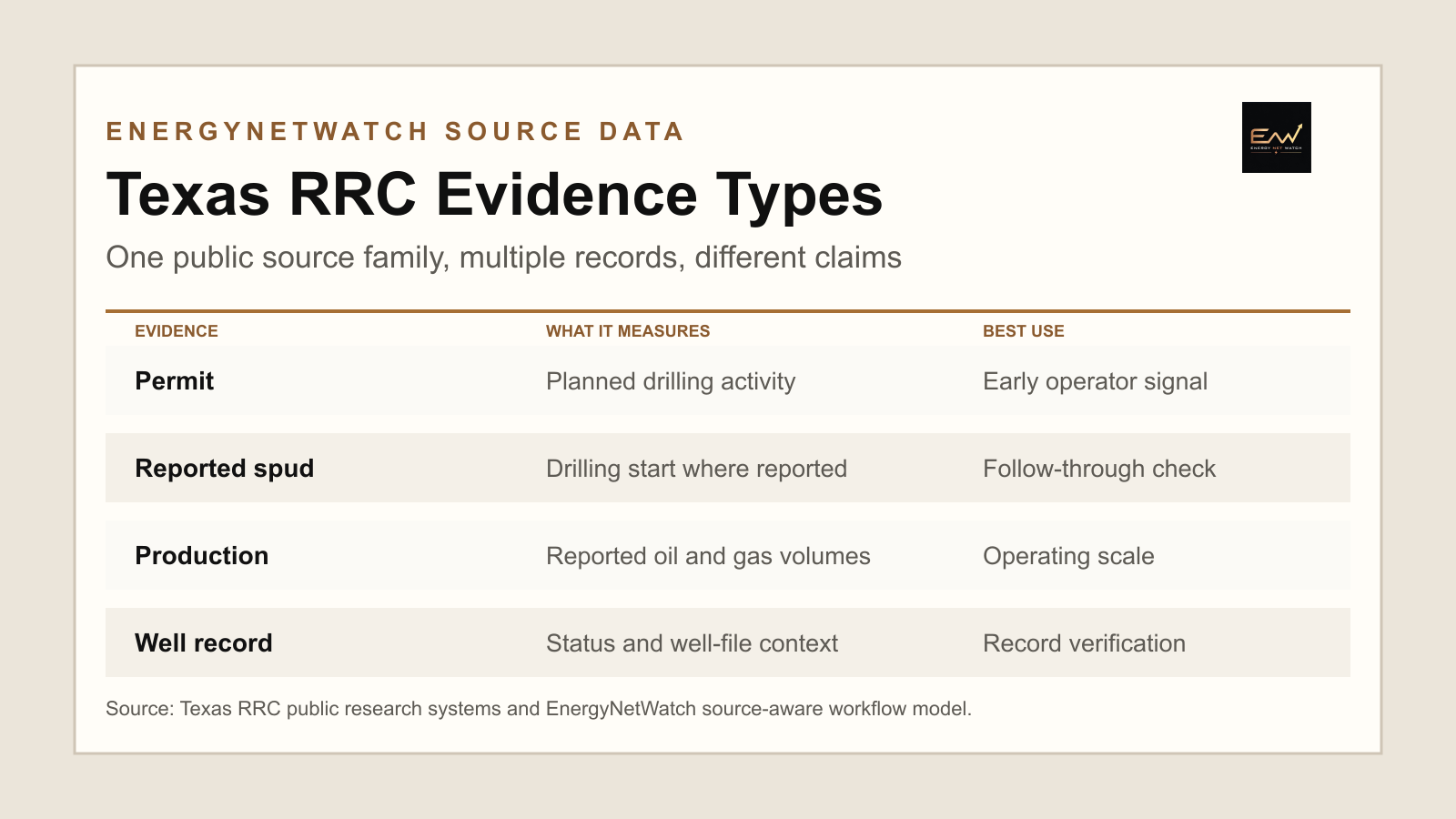
Texas RRC data is strongest when each evidence type is kept separate before ranking, mapping, exporting, or saving alerts.
Texas RRC Production Data
The RRC Production Data Query, often called PDQ, is the starting point for Texas oil and gas production research. The RRC describes production information as reported to the Commission by Texas operators, and its PDQ FAQ states that production information is taken directly from operator-submitted reports.
That matters because Texas production data is regulatory reporting, not a commercial estimate.
Texas production structure matters. Oil production is commonly reported at the lease level, not always at the single-well level users expect. The RRC well-records page notes that oil and gas production from 1993 forward is available online and that oil production is reported by lease while gas is reported by well.
For analysts, this creates a real workflow problem. A lease can include multiple wells. A county can include leases that cross county boundaries. An operator can appear under different legal labels. A single production table will not answer every question without source-aware joins.
Production Questions The Data Can Support
| Question | Good source basis |
|---|---|
| Which operators have the largest latest reported Texas production? | Operator monthly production rollup |
| Which counties are producing the most oil or gas? | County production summaries and normalized production rollups |
| What is the latest reported production month? | Source-date/freshness check |
| What did one lease report? | RRC production query or normalized lease production records |
| What did one well produce? | Requires Texas-specific allocation or well-level source handling |
Production is the right table for scale. It is not the right table for immediate drilling intent.
Texas Drilling Permits
Texas drilling permits are a different evidence type than production. They are earlier in the activity cycle.
The RRC provides a Drilling Permit, Form W-1, query for searching permit records. The RRC well-records page also identifies Form W-1 applications and location plats as part of the well-record system, with applications after May 2005 available electronically through the Drilling Permit query.
Permits are useful because they show planned activity before production appears. They are not proof that a well has been drilled, completed, or produced.
Permit Questions The Data Can Support
| Question | Good source basis |
|---|---|
| Which operators filed the most recent permits? | Permit issue/filed date by operator |
| Which counties are seeing planned activity? | Permit county and location records |
| Which permits have bottom-hole or surface location context? | Permit location segments and GIS joins |
| Which permits became spudded records? | Permit-to-spud linkage where the source supports it |
Permit data is strongest when it keeps the source window visible. A May permit leaderboard can be valid even when the latest loaded production month is March and the latest loaded spud date is earlier than the permit window.
Texas Reported Spuds
A reported spud is closer to field activity than a permit. It marks the start of drilling where the source has a reported spud date.
The important rule is direct: do not force a current spud claim unless the source date supports it.
In the June 9, 2026 EnergyNetWatch Texas pull, May permit records were available through May 28, 2026. The loaded Texas spud field reached April 1, 2026. That means May permit leaders and 2026 reported-spud leaders are valid as separate tables, but the spud table cannot be labeled as a same-month May ranking on that pull.
That distinction is not a weakness. It is how source-aware oil and gas data should be presented.
Texas Well Records And Wellbore Data
Texas well records contain the context that production and permits do not provide by themselves.
The RRC oil and gas well-records page describes well records from 1964 to present as available through the Oil and Gas Imaged Records Query, Public GIS Viewer, and Wellbore Query. It lists applications to drill, completion reports, plugging reports, P-4 records, correspondence, pressure curves, directional surveys, and related well-file material.
The RRC's oil and gas query pages also include Wellbore Query, P-4 Gatherer/Purchaser Query, proration queries, inactive well queries, orphan well queries, and organization queries. These source systems help answer questions that production alone cannot answer.
Well-Record Questions The Data Can Support
| Question | Good source basis |
|---|---|
| Is the well active, inactive, plugged, or historical? | Wellbore status and status reports |
| What completion or plugging records exist? | Imaged records and well-file data |
| Which operator is currently associated with the record? | Operator-of-record sources and normalization |
| Where is the well located? | GIS/public map coordinates and permit location records |
Well records also help explain why operator names differ. The state record usually carries a legal/operator label. A commercial parent-company view requires additional identity work and should not be assumed from a single string match.
Source Dates Matter In Texas RRC Data
Texas data is strong, but it is not real-time across every table.
The RRC PDQ FAQ states that production reports are due at the end of the month for the previous month, creating a two-month lag for online production information. It also notes that production data is a snapshot in time and can change as revised, corrected, or delinquent reports arrive.
For public content and operational workflows, EnergyNetWatch separates the evidence types:
| Evidence type | What it measures | Typical use |
|---|---|---|
| Permit records | Planned drilling activity | Early operator/county signal |
| Reported spuds | Drilling activity where reported | Follow-through from permits |
| Production records | Reported operating scale | Operator/county production comparison |
| Well records | Status and source context | Well-level due diligence |
| GIS/location data | Surface and spatial context | Maps, offsets, county/basin workflows |
The source date should travel with the record into every table, export, chart, saved workflow, and API response. Otherwise, a correct-looking chart can support the wrong conclusion.
How EnergyNetWatch Uses Texas RRC Data
EnergyNetWatch connects Texas data into workflows instead of leaving it as separate source pages.
In practice, that means a high-level question can move into the source records:
- Top operators by permit records
- Latest reported production by operator
- Reported spuds by operator
- County and map context
- Well records and production history
- Exports, alerts, and API access
Texas data becomes more useful when it is normalized, searchable, mapped, dated, and connected to the next action.
For example, a Texas operator workflow can start with a permit leaderboard, move into county concentration, check reported spuds, compare latest reported production, and then export the records or save an alert. A source portal can answer the individual lookup. EnergyNetWatch is designed for the recurring workflow.
Related Texas RRC Workflows
- Texas oil and gas production data explains production reporting, operator labels, well context, and source lag.
- Texas drilling permits API shows the operator, county, date-window, export, and permit-alert workflow.
- Well lookup by API number covers normalized well identifiers and record-level lookup.
- Texas RRC well and production API shows the complete API-number-to-official-identity, completion, lease, and filed-production sequence.
- Texas RRC T-4 pipeline permits with GIS route evidence keeps pipeline permit, PS-48 construction-notice, and mapped route evidence in their separate record stages.
- Texas state watchlist provides the current statewide permit, reported-spud, and production source clocks.
Frequently Asked Questions
Is Texas RRC data public?
Yes. Texas RRC data is public regulatory data. The challenge is source structure, lag, format, and joins across production, permits, well records, and locations.
Is Texas production data real-time?
No. The RRC PDQ FAQ states that production reporting creates a two-month lag for online production information, and records can change as revised or corrected reports arrive.
Are drilling permits the same as drilled wells?
No. A permit is planned activity. A reported spud is a separate record type that indicates drilling activity where a spud date is available.
Why do operator names differ across Texas records?
State-source records are attached to legal/operator labels as reported in the source system. Operator identity work is needed when users want parent-company views, acquisition context, or consolidated activity.
Sources
- Texas RRC Production Data Query FAQ
- Texas RRC Research Queries
- Texas RRC Production Data
- Texas RRC Oil and Gas Well Records
- Texas RRC Oil and Gas Data Query
Need Texas permit, production, spud, well-record, map, export, alert, or API workflows without rebuilding the RRC joins yourself? Request EnergyNetWatch access.
Data notes
This guide uses public Texas Railroad Commission source documentation reviewed June 10, 2026 and EnergyNetWatch workflow conventions. Texas production, permit, spud, well-record, and GIS records carry different source dates and should not be treated as one interchangeable dataset.
Recommended next pages
Texas Drilling Permits By Operator: May Permits, Reported Spuds, And Production (2026)
Texas drilling permits by operator for May 2026, with latest reported production and 2026 reported spud leaders from EnergyNetWatch.
Oil And Gas Data Freshness: Why Permits, Spuds, And Production Dates Differ (2026)
Oil and gas data freshness guide explaining why permits, reported spuds, and production records have different source dates.
RRC Production Data Query | Texas Oil & Gas by Lease
Look up Texas RRC production data by lease, operator, and month. Lease grain, not well.
Texas Drilling Permits by Operator: May 2026 Permit and Spud Activity Snapshot
Texas operators ranked by trailing 90-day drilling permits, with recent reported spuds and source freshness notes from EnergyNetWatch.
Related EnergyNetWatch pages
Want the current table behind this analysis?
Public articles use selected examples. Request access if your team needs current source refreshes, exact identifiers, maps, exports, alerts, saved workflows, or API access for this market.