
Operator Activity Chase Lists: Turning Public Oil And Gas Records Into Account Workflows (2026)
Build operator activity chase lists from oil and gas permits, spuds, completions, source dates, and account-ready EnergyNetWatch records.
By Johnathan · Reviewed by EnergyNetWatch Research · Evergreen guide · Content updated 2026-09-12
Living operator brief
This page is maintained as an operator intelligence brief, with refreshed permits, spuds, production windows, counties, source labels, and watch items where available.
Key Takeaways
- Operator rankings become more actionable when drilled evidence, permit queues, source dates, and operator-label scope travel with the account list.
- The Reagan preview covers 79 of 81 permit records and five of seven source-filed labels; a complete ranking requires the remaining records.
- The strongest next step is a source-backed table that can become a map review, export, alert, or API feed.
An operator ranking is a useful starting point, but it is not a sales workflow by itself.
If the question is "who should we call next?", a ranked list needs more than one activity count. It needs to show which record created the signal, whether the operator label is clean, whether permits are ahead of drilled evidence, and whether the activity is fresh enough to act on.
That is the difference between a public ranking and an EnergyNetWatch operator chase list. The ranking names accounts. The chase list tells a business-development, commercial, or data/API user what to check next.
This guide now includes a county-to-account workflow reviewed September 12, 2026. The June 17 operator ledger and graphic remain below as historical examples; they are not today's prospect list. In that older pull, drilled evidence means reported spud rows plus completion-implied wells. Permit evidence is separate and should not be described as drilled wells.
Build An Oil And Gas Prospect List From County Permit Records
Start with a territory and a question you can check: “Which source-filed operators have permit records in Reagan County, Texas, during this window?” That produces an account-research list. It does not identify a purchasing contact, an open bid or a confirmed need for your services.
1. Write Down The Selection Rules
The worked example uses the Reagan County permit page reviewed September 1, 2026. Its Texas permit window is May 29–August 27, 2026, with canceled records excluded. County assignment uses the county segment of valid well API identifiers. The county has 81 permit records across seven source-filed operator labels in that snapshot.
These are permit records, not 81 unique newly drilled wells. The snapshot reports zero spud events in its separate spud window; that does not establish that no drilling occurred. Do not mix permit and spud dates into a single activity period.
2. Keep The Source-Filed Operator Names
| Source-filed operator label | Permit records | Latest permit in the snapshot |
|---|---|---|
| DE CENTRAL OPERATING, LLC | 38 | August 11, 2026 |
| PIONEER NATURAL RES. USA, INC. | 30 | August 14, 2026 |
| BLACK SWAN OPCO, LLC | 7 | July 1, 2026 |
| DISCOVERY NATURAL RESOURCES LLC | 3 | August 12, 2026 |
| HANNATHON PETROLEUM II, LLC | 1 | August 18, 2026 |
The five displayed labels cover 79 of 81 records. Two records and two other labels sit outside this preview. Request or retrieve the full filtered table before calling it a complete county ranking. DE CENTRAL and Pioneer together account for 68 records, or 84.0% of the snapshot; that concentration is a reason to inspect their filings, not evidence of their purchasing budgets.
Keep a separate “reviewed parent account” column if your CRM uses corporate-family names. Leave it unconfirmed until you have identity evidence. Do not overwrite the filed operator label or merge companies solely because their names look related.
Need the full county table reviewed for your territory? Request a Reagan County research scope. Include your service area, date window and required fields. Scope, availability and delivery are agreed before purchase; contacts and scheduled updates are not assumed inclusions.
3. Retrieve Records Before Ranking Accounts
For a programmatic starting point, use the Reagan County REST example with your own authorized key. It requests state=TX, county=Reagan, days=90, page=1 and limit=5. A five-row response is a sample, not the full county list.
Follow data.pagination.nextPage while hasMore is true, within your request budget. Retain the retrieval time, data.countWindow, county-selection metadata, filters and permit identifiers. Aggregate only after the intended pages have been collected. If you stop early, label the output partial and record the pages received.
The REST query uses a rolling lookback relative to the request date and does not expose fixed start/end dates. Its cancellation rules also differ from the dated public snapshot. A new API pull is therefore a new list, not an exact reproduction of the 81-record example. Check API pricing before pagination: each page is another metered request.
4. Turn The Table Into A Review Queue
| Working column | Review rule |
|---|---|
| State, county and permit identifier | Preserve geography and identity; check duplicates before counting |
| Exact operator label and reviewed parent account | Store separately; mark unknown parent mappings |
| Permit purpose, status and issue date | Check what was filed and when before inferring a relevant project |
| Well API and available spud/completion evidence | Use separate lookups; missing evidence is not a negative event |
| Source window, retrieval time and completeness | Make the list reproducible and disclose partial pagination |
| Account fit, next action and owner | Analyst-added fields, not facts supplied by the regulator |
Your first action might be “review DE CENTRAL's permit purposes against our service territory,” followed by “verify the relevant business unit and contact through company sources.” A permit is a reason to research an account. It is not permission to claim the company is actively buying your service.
5. Use AI To Summarize The Export, Then Review It
Using only this county permit export, group records by exact source-filed operator label. Show counts and earliest/latest issue dates. State filters, source window, retrieval date and whether pagination finished. Flag duplicate or missing identifiers. Keep parent-account suggestions separate and unverified. Do not infer drilling, production, purchasing intent or personal contacts from a permit.
This prompt analyzes an exported table. It does not assert that the MCP permit tool accepts a county filter: the checked MCP 0.1.10 permit-search schema does not. Check supported MCP workflows before using an agent to collect records; do not silently substitute statewide rows for a county query.
For the next edition, rerun the same documented selection rules, compare permit identifiers and record actual source dates. Report “new to this export” separately from “newly issued.” Keep the previous edition so a change in filters or late-arriving records does not become a false growth claim.
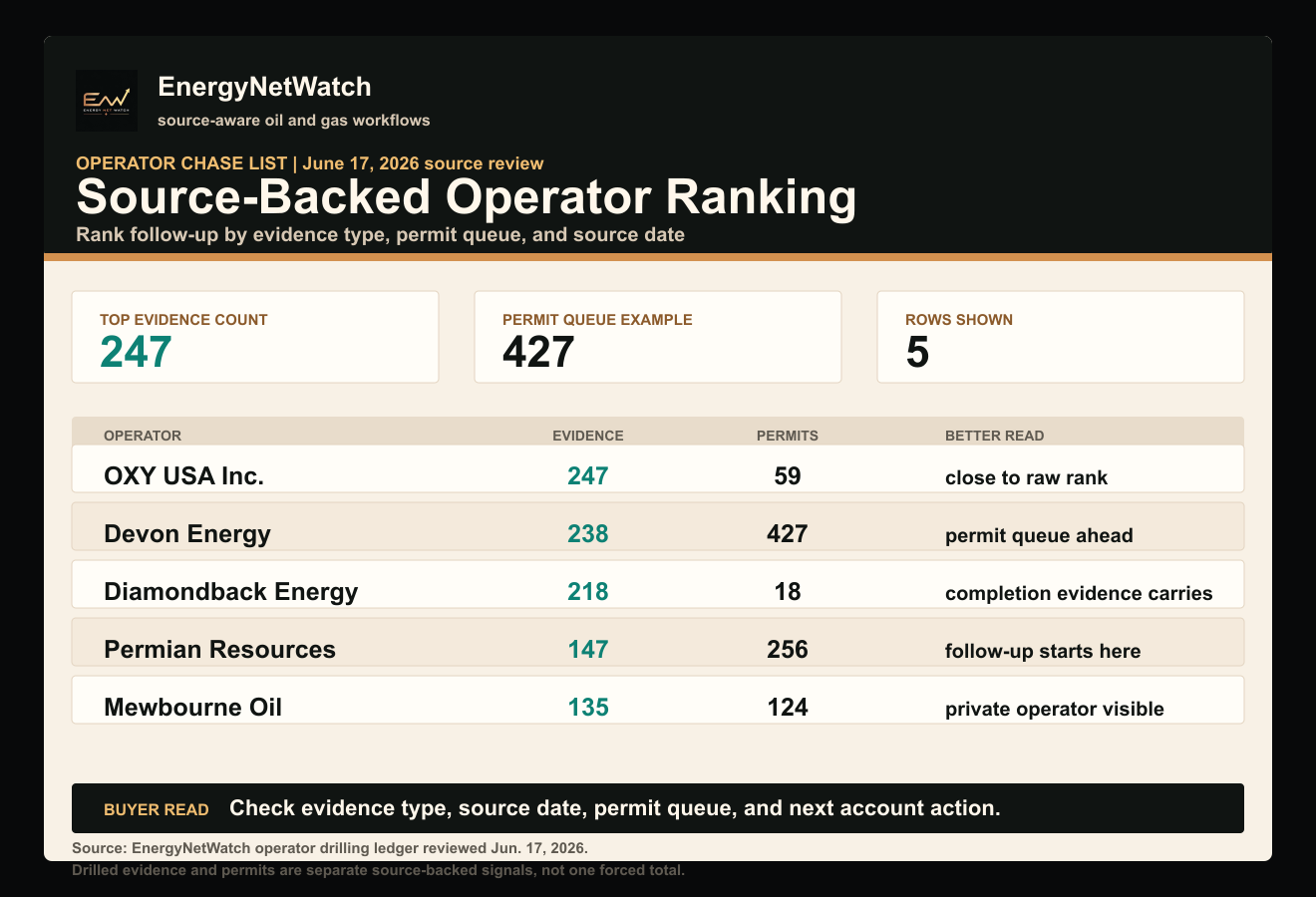
Historical June 17, 2026 operator chase-list snapshot. These counts were not refreshed with the September county workflow update.
Why Operator Rankings Need A Source Check
A simple operator ranking is attractive because it is fast to read. It creates a short list of recognizable names: OXY, Devon, Diamondback, Permian Resources, EOG, Exxon, Chevron, SM Energy / Civitas, Mewbourne, and other large accounts.
That makes the list useful for attention. It does not make the list complete enough for outreach, diligence, territory planning, or an API workflow.
The first problem is evidence type. A "wells drilled" number may come from reported spud records, completion records, modeled activity, rig feeds, company aggregation, or a vendor definition that blends several inputs. Those are not the same record. A service-company seller may care about current permits before completion. An analyst may care about drilled evidence. A data buyer may need the row-level fields behind both.
The second problem is operator identity. State-source labels often do not match parent-company labels cleanly. XTO and Exxon, Pioneer and Exxon, OXY USA and broader Occidental labels, SM Energy and Civitas, Chevron and acquired labels, and ConocoPhillips and Burlington-style labels all require review before a table becomes a parent-company workflow.
The third problem is timing. A permit queue can be current while completion-implied evidence lags. Reported spud rows may be strong in one source window but incomplete for a newer period. A table can be accurate and still answer the wrong business question if the source window is hidden.
Historical June 2026 Operator Chase-List Snapshot
The June 17 pull ranks selected operators by EnergyNetWatch drilled evidence year to date, then shows the permit queue separately.
| Rank | Operator | ENW drilled evidence YTD | Source split | ENW permits YTD | Better signal |
|---|---|---|---|---|---|
| 1 | OXY USA Inc. | 247 | 18 spud / 229 completion-implied | 59 | Close to raw rank; source basis matters |
| 2 | Devon Energy | 238 | 46 spud / 192 completion-implied | 427 | Permit signal is ahead of drilled evidence |
| 3 | Diamondback Energy | 218 | 10 spud / 208 completion-implied | 18 | Completion evidence carries the count |
| 4 | Permian Resources | 147 | 43 spud / 104 completion-implied | 256 | Permits show where follow-up starts |
| 5 | SM Energy / Civitas | 136 | 16 spud / 120 completion-implied | 51 | Merged labels need source review |
| 6 | Mewbourne Oil | 135 | 9 spud / 126 completion-implied | 124 | Private operator activity is still visible |
| 7 | EOG Resources | 128 | 76 spud / 52 completion-implied | 380 | Large permit queue; drilled evidence lags |
| 8 | Exxon (XTO) | 116 | 23 spud / 93 completion-implied | 276 | Large raw-list gap; latest evidence Apr. 22 |
The rank is only useful when the source evidence travels with it.
Devon and EOG show why. Both have large permit queues relative to drilled evidence in this record set. That can be a better outreach signal than drilled-evidence rank alone. Field services, water, sand, chemicals, logistics, land services, software, and data teams often need to know where the permit queue is forming before those records appear in production history.
Diamondback shows the opposite problem. Its drilled evidence is strong, but much of the count is completion-implied in this pull. That can still be useful, but it should be treated differently from a table dominated by reported spud rows.
Mewbourne is also important. Private operators can disappear from broad public-company commentary even when they matter in a current activity workflow. A source-backed operator table keeps those accounts visible.
From Rank To Account Action
A better operator chase list should answer five questions before anyone exports the account list:
| Workflow question | Why it matters |
|---|---|
| What record created the signal? | Permits, reported spuds, completions, and production each support different claims. |
| Is the operator label clean? | Parent/subsidiary, acquired, and legacy labels can change the account signal. |
| Is activity fresh enough to act on? | Source date and latest evidence date determine whether a call list is current. |
| Where is the activity? | County, state, basin, and map context turn a rank into a territory plan. |
| What should happen next? | The right output may be a call list, saved alert, export, map review, or API feed. |
That structure is stronger than a static leaderboard because it connects the count to the next action.
For BD teams, the table can become a territory workflow: review permit-heavy accounts, filter by county, check whether activity is new or continuing, then save the operator/county watchlist.
For a commercial analyst, it can become a diligence workflow: separate evidence types, compare latest source dates, review operator labels, and avoid treating a parent-company rollup as a state-source fact.
For data/API teams, it can become an integration workflow: request the operator activity endpoint or export with operator label, parent-review status, record type, source date, permit issue date, reported spud date, completion-implied flag, county, state, and latest production context.
How EnergyNetWatch Uses This In The App
The public graphic is intentionally small. The live app workflow is broader:
- Start with an operator or account group.
- Separate permits, reported spuds, completion-implied evidence, production history, and infrastructure signals.
- Keep the source date and measurement window attached to each record.
- Review operator labels before rolling records into a parent-company view.
- Move from the summary table into maps, county filters, exports, alerts, and API access.
EnergyNetWatch is not trying to make another generic ranked table. It is turning public records into a record-backed workflow for inspection, export, monitoring, and explanation.
What To Ask For
For operator activity review, ask for the exact table:
Request the current operator chase-list table with operator label, reviewed parent group where available, state, county, permit count, reported spud count, completion-implied drilled evidence, latest evidence date, latest permit issue date, latest production month, source-date caveat, map link, export option, alert option, and API fields.
That request is stronger than "send me the top operators." It ties the export to the actual account-screening question.
Need a reviewed account-research table for your county? Request a county activity-table scope, specifying state, county and date window. For repeated programmatic pulls, compare prepaid API credits. Maps, contacts, alerts and custom delivery should be scoped separately rather than assumed from a permit export.
Frequently Asked Questions
Is this a wells-drilled ranking?
It is not a generic wells-drilled ranking. The EnergyNetWatch table separates drilled evidence into reported spud rows and completion-implied wells, then shows permit evidence separately.
Why not combine permits and drilled evidence into one activity score?
Permits and drilled evidence answer different questions. A permit can show intent or a queue. Reported spud and completion-implied evidence can show field activity. Combining them without labels can make the table easier to scan but weaker for decisions.
Why do operator labels matter?
State-source operator labels may not match parent-company labels. Acquisitions, subsidiaries, legacy operating names, and source-system naming rules can all affect the account view. A commercial workflow should show when parent-level grouping has been reviewed.
Can this become an alert or API workflow?
Yes. The same record fields can support saved account alerts, county watchlists, exports, and approved API access when the workflow needs repeatable monitoring instead of one static table.
What belongs in the first comparison?
Start with evidence type, source date, county/state concentration, and operator label scope. Those four checks usually explain why two operator rankings can look different while both are using real records.
Source And Caveat
County example: September 1, 2026 EnergyNetWatch ECS/RDS county snapshot, permit period May 29–August 27, 2026, reviewed for this guide September 12. Reagan's five displayed labels sum to 79; county totals are 81 records and seven labels. The instructional update does not refresh the historical county or June operator counts. County/API filter differences are documented above and on the linked county page.
EnergyNetWatch operator drilling ledger queried June 17, 2026. Year-to-date drilled evidence in this public snapshot means reported spud rows plus completion-implied wells where the reviewed source fields support that treatment. Permit counts are counted separately from drilled evidence. Public article values are a reviewed summary and should not be treated as a full export of the underlying app records.
Data notes
Workflow reviewed September 12, 2026. Reagan example retains the September 1 county snapshot and May 29–August 27 permit window; it is not a current rolling API total. June 17 operator-ledger values and artwork remain historical, with spud and completion-implied evidence separate from permits.
Recommended next pages
Texas Drilling Permits By Operator: May Permits, Reported Spuds, And Production (2026)
Texas drilling permits by operator for May 2026, with latest reported production and 2026 reported spud leaders from EnergyNetWatch.
How to Track Drilling Permits by Operator Before Production Shows Up (2026)
Learn how to track drilling permits by operator, connect permits to later production signals, and avoid common state-source mistakes.
Oil And Gas Data Freshness: Why Permits, Spuds, And Production Dates Differ (2026)
Oil and gas data freshness guide explaining why permits, reported spuds, and production records have different source dates.
Oil and Gas Data API for Public Energy Data Workflows
Learn how to evaluate oil and gas data APIs, source context, coverage, fields, and delivery choices before comparing commercial integration options.
Related EnergyNetWatch pages
Want the current table behind this analysis?
Public articles use selected examples. Request access if your team needs current source refreshes, exact identifiers, maps, exports, alerts, saved workflows, or API access for this market.