
Texas Infrastructure Records: Chase-Ready Oil And Gas Leads (2026)
EnergyNetWatch reviews 36,112 Texas infrastructure records by source date, facility type, operator, county, and chase-ready lead quality.
By Johnathan · Reviewed by EnergyNetWatch Research · Evergreen guide
Key Takeaways
- EnergyNetWatch reviewed 36,112 Texas TCEQ facility records, including 7,446 active records and 3,766 represented operators.
- The current activity layer is narrower: 239 source-effective rows in the trailing 90-day window, led by Martin, Midland, Upton, Ward, Shelby, Reagan, and Reeves counties.
- Chase-ready records account for 65.4% of the Texas infrastructure snapshot when operator, county, source, facility, and location detail support follow-up.
Texas infrastructure records are useful when treated as a workflow, not a raw row count.
The current Energy-NetWatch Texas Infrastructure snapshot shows 36,112 TCEQ facility records, including 7,446 active records and 3,766 represented operators. That is the coverage base. The operating signal comes from a narrower layer: source-dated records, facility names, facility type, operator, county, and whether a record has enough detail to support follow-up.
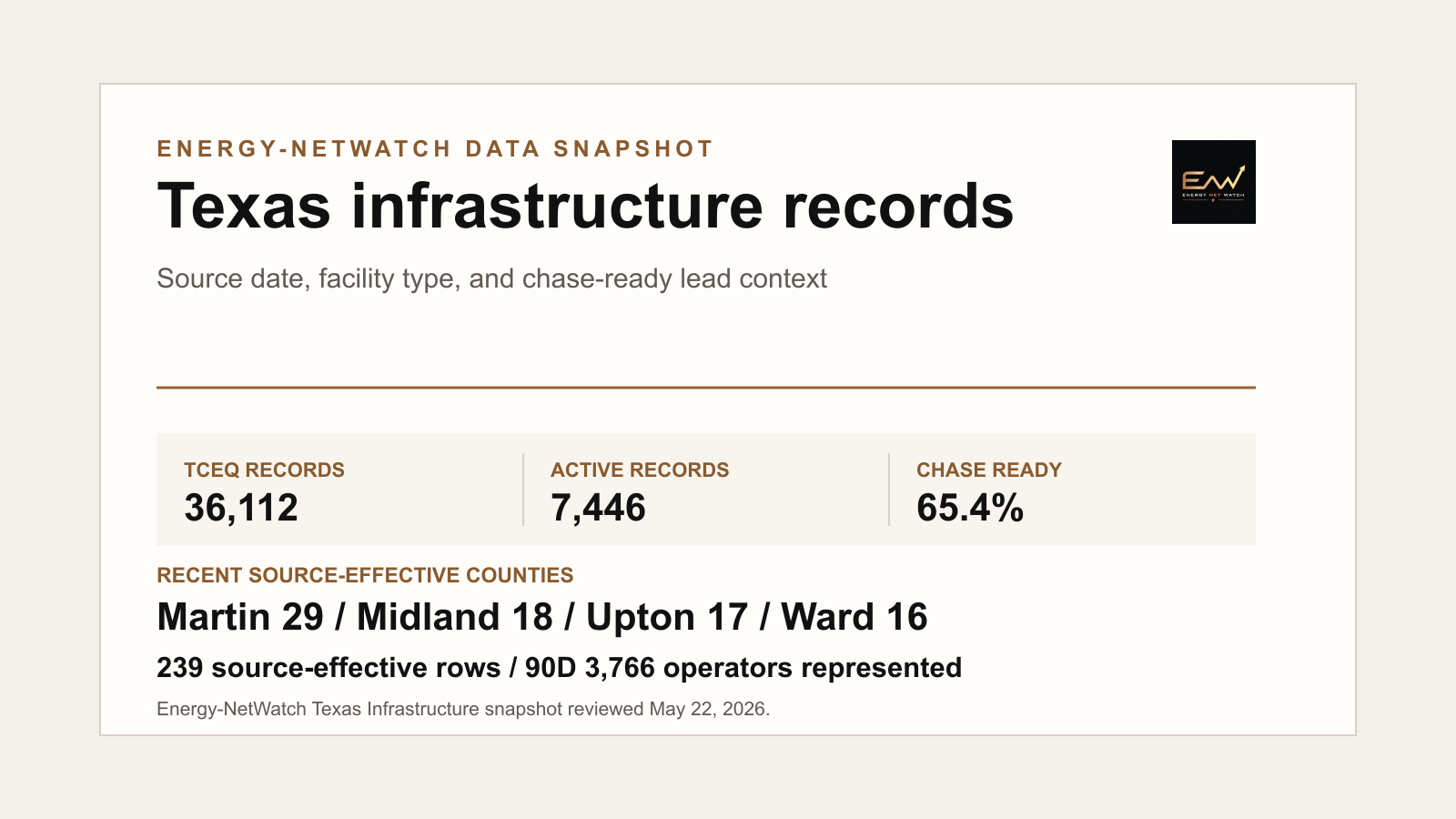
Energy-NetWatch Texas infrastructure snapshot reviewed May 22, 2026. Public figures are rounded and designed to show the workflow, not the full working dataset.
For operators, service companies, midstream teams, environmental vendors, and data teams, that distinction is the product value. A facility row is not automatically a project. It becomes useful when the source date, facility type, operator, county, and follow-up context are visible.
That distinction matters because a newly surfaced record is not always a new field event. A row can be newly observed because a source was expanded, backfilled, or added to a normalized workflow. The better signal is to separate source activity date from first-observed date.
| Layer | What it answers |
|---|---|
| Source activity date | When the source record appears to describe activity |
| First observed date | When Energy-NetWatch first saw or loaded the row |
| Facility type | Whether the row points to compression, CTB, SWD, pad/site work, gas plant, water, or other facility context |
| Chase readiness | Whether the row has enough operator, county, source, facility, and location detail for follow-up |
Texas Infrastructure Records Snapshot
| Metric | Current snapshot |
|---|---|
| TCEQ facility records | 36,112 |
| Active records | 7,446 |
| Operators represented | 3,766 |
| Latest ingest reviewed | May 22, 2026 |
| Source-effective rows in last 90 days | 239 |
| Rows first observed in last 30 days | 36,112 |
The most important number in that table is not the largest one. It is the gap between source-effective rows in the last 90 days and rows first observed in the last 30 days.
The first number is better for current activity. The second number is better for coverage expansion. Both are useful, but they answer different questions.
For current infrastructure records, operator context, maps, exports, alerts, and API access, request Energy-NetWatch access.
Recent Texas County Signals
The strongest recent Texas county signals by source-effective facility date were concentrated in core Permian counties plus selected East Texas and South Texas activity.
| County | Source-effective rows in last 90 days |
|---|---|
| Martin | 29 |
| Midland | 18 |
| Upton | 17 |
| Ward | 16 |
| Shelby | 16 |
| Reagan | 15 |
| Reeves | 14 |
For a business-development user, that county list is a routing layer. The stronger lead is operator plus county plus facility type plus source date.
Why This Beats A Basic Permit List
Most public-data workflows stop at a row list. That is not enough for infrastructure.
| Basic list | Energy-NetWatch workflow |
|---|---|
| Shows a facility row | Separates source date, first-observed date, facility type, and chase readiness |
| Treats all new rows similarly | Distinguishes current source activity from coverage expansion |
| Leaves classification messy | Uses facility text to identify compressor, CTB, SWD, pad, production facility, and related records |
| Requires manual context | Connects the row to operator, county, wells, permits, production, maps, and midstream context |
| Hard to route commercially | Turns rows into account, county, and facility follow-up screens |
Infrastructure data becomes more useful when the record can be routed. A compressor station record, a central tank battery record, and a saltwater disposal record may all appear in a facility table, but they point to different users, different workflows, and different follow-up questions.
Operator And Facility Examples
| Operator / account | County signal | Facility names or type signal | What to check |
|---|---|---|---|
| WTG Gas Processing LP | Howard / Martin | Compressor station records | Compression, controls, emissions, measurement, power, and station maintenance follow-up |
| ETC South Permian Midstream / ET Gathering & Processing | Reagan / Martin | Compressor station records | Gas gathering and compressor-station account review |
| Endeavor Natural Gas LP | Dimmit | CTB and compressor/tank-battery records | Tanks, automation, vapor control, measurement, and facility-support angle |
| Petro-Hunt Permian / Anadarko E&P Onshore | Loving | Central tank battery and well-pad records | Delaware Basin surface-facility follow-up |
| Williams Midstream Gas Services | Wheeler | Compressor station records | Panhandle compressor reliability and maintenance follow-up |
These examples should not be treated as a construction forecast. They are source-record leads for follow-up review.
What A Chase-Ready Infrastructure Row Needs
A row becomes useful for follow-up when it has enough fields to support account, county, facility, and map review.
| Readiness bucket | TX records | Share |
|---|---|---|
| Chase Ready | 23,627 | 65.4% |
| Needs Review | 5,547 | 15.4% |
| Sparse Lead | 6,938 | 19.2% |
The missing-field profile explains why this matters.
| Missing field | TX records |
|---|---|
| Known status | 27,841 |
| Source permit date | 11,738 |
| Registration number | 11,203 |
| Operator | 6,971 |
| Location detail | 6,934 |
A source-aware infrastructure workflow should show this confidence layer directly. A sales, midstream, service, or data team should know whether it is looking at a clean lead, a source-review row, or a sparse row that needs enrichment.
What This Lets Users Do
Energy-NetWatch infrastructure records are strongest when they become an account workflow:
- Filter for recent source-dated activity, not first-observed coverage expansion.
- Group by operator, county, and facility type.
- Prioritize compressor stations, CTBs, SWDs, clean brine facilities, well pads, and production facilities.
- Check whether the row is chase ready.
- Cross-check the same county and operator against permits, wells, production, maps, and midstream context.
That workflow turns infrastructure records from a static table into a lead-qualification layer.
Example Infrastructure Workflow
| Step | Energy-NetWatch view | User decision |
|---|---|---|
| 1 | Filter Texas infrastructure rows to recent source-dated activity | Avoid treating coverage-expanded rows as new field events |
| 2 | Group by operator and county | Build an account list rather than a broad county list |
| 3 | Review facility type and facility text | Separate compressor, CTB, SWD, pad, production facility, and other leads |
| 4 | Check chase readiness | Prioritize rows with operator, county, source date, source reference, and usable location/facility detail |
| 5 | Cross-check wells, permits, production, maps, or midstream context | Decide whether the facility record supports a real operating conversation |
For sales, service, midstream, equipment, environmental, automation, and data teams, that is the difference between a row dump and a usable account screen.
What To Watch Next
| Watch item | Why it matters |
|---|---|
| Martin, Midland, Upton, Ward, Shelby, Reagan, and Reeves source-dated rows | Current county routing layer |
| Compressor-station records | Useful for compression, controls, emissions, power, and maintenance workflows |
| CTB and tank-battery records | Useful for tanks, automation, vapor control, measurement, and site services |
| Sparse leads | Need enrichment before they should be treated as high-confidence follow-up |
| First-observed spikes | Useful for coverage expansion, but not proof of new field activity |
Bottom Line
Texas infrastructure data is valuable, but only when timing and source quality are visible. The current EnergyNetWatch signal shows broad TCEQ facility coverage, a smaller current source-dated activity layer, and specific operator/county/facility examples that can support real follow-up.
The best public-data takeaway is simple: do not treat every newly surfaced infrastructure row as new activity. Treat source-dated, chase-ready, facility-specific records as the operating lead.
For current infrastructure records, operator context, maps, exports, alerts, and API access, request Energy-NetWatch access.
Frequently Asked Questions
What are Texas infrastructure records in Energy-NetWatch?
They are public Texas facility records organized by operator, county, facility type, source timing, and follow-up context. In this snapshot, Energy-NetWatch reviewed 36,112 TCEQ facility records.
Is a newly observed infrastructure row the same as new field activity?
No. A newly observed row may reflect a source expansion or coverage update. For operating follow-up, the better signal is source-effective date plus facility type, operator, county, and chase readiness.
What does chase-ready mean?
Chase-ready means the row has enough context to support practical follow-up: operator, county, source reference, facility detail, and usable location or source information. Sparse rows may still be useful, but they need more review.
How is this different from a drilling permit?
A drilling permit usually points to planned well activity. Infrastructure records can point to facility, compression, tank battery, SWD, pad, production facility, or other surface and midstream-adjacent signals. The workflows overlap, but they are not the same record type.
Can Energy-NetWatch connect infrastructure records to wells and maps?
Yes. The app workflow is designed to move from infrastructure records into operator, county, map, well, permit, production, export, alert, and API workflows where source coverage supports that connection.
Data notes
EnergyNetWatch Texas Infrastructure figures are rounded public-record snapshot values reviewed May 22, 2026. TCEQ facility records, source-effective dates, first-observed dates, facility types, counties, and chase-readiness buckets are used for source-level monitoring, not construction forecasting.
Recommended next pages
Texas T-4 Pipeline Permits: How Midstream Infrastructure Leads Work
Texas T-4 pipeline permits can become midstream infrastructure leads when matched to route, operator, county, and source context.
Texas Drilling Permits by Operator: May 2026 Permit and Spud Activity Snapshot
Texas operators ranked by trailing 90-day drilling permits, with recent reported spuds and source freshness notes from EnergyNetWatch.
Diamondback Energy Texas Drilling Permits: Q1 2026 Follow-Through
Diamondback operator intelligence brief covering Texas permit rank, reported-spud follow-through, sample well context, and T-4 infrastructure lead evidence.
RRC Production Data Query | Texas Oil & Gas by Lease
Look up Texas RRC production data by lease, operator, and month. Lease grain, not well.
Related EnergyNetWatch pages
Want the current table behind this analysis?
Public articles use selected examples. Request access if your team needs current source refreshes, exact identifiers, maps, exports, alerts, saved workflows, or API access for this market.