
Oil And Gas Infrastructure Records: Facility Evidence vs Lead Signals (2026)
EnergyNetWatch separates oil and gas infrastructure records by evidence basis: Texas facility permits, New Mexico leads, T-4 signals, and state-source leads.
By Johnathan · Reviewed by EnergyNetWatch Research · Last updated 2026-06-08
Key Takeaways
- EnergyNetWatch beta verification on June 7, 2026 checked 36,112 Texas facility records, 6,574 New Mexico infrastructure leads, 88 Texas T-4 project signals, and 1,050 state-source midstream leads.
- Each row carries an evidence basis into the workflow: table, detail view, report, CSV export, and package request.
- State-source leads support follow-up workflows, but they should not be described as confirmed pipeline assets, complete facility inventories, or in-service infrastructure without source support.
EnergyNetWatch is tightening how infrastructure records are labeled in the app: confirmed facility evidence, route-backed Texas T-4 records, and state-source lead signals are separated before a user exports, reports, or packages the data.
The reason is practical. A Texas facility permit record, a Texas RRC T-4 pipeline permit with route context, and a New Mexico permit or surface-location lead can all support infrastructure review. They should not be flattened into one generic record type.
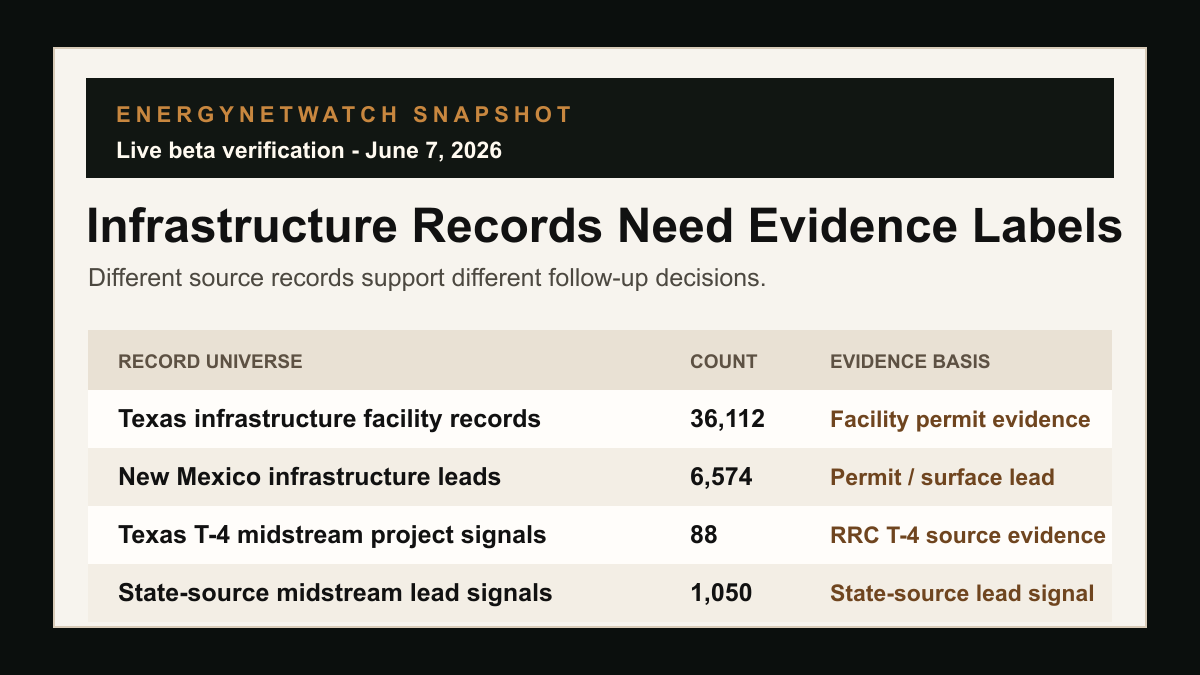
EnergyNetWatch beta verification reviewed June 7, 2026. Counts show current workflow row universes and evidence basis labels, not all-state parity claims.
Oil And Gas Infrastructure Records Snapshot
Measurement universe: authenticated EnergyNetWatch beta verification on June 7, 2026.
| Workflow | Current rows checked | Evidence basis |
|---|---|---|
| Texas infrastructure facility records | 36,112 | Texas facility permit evidence |
| New Mexico infrastructure lead records | 6,574 | NM permit / well-surface lead |
| Texas T-4 midstream project signals | 88 | RRC T-4 source evidence |
| State-source midstream lead signals | 1,050 | Drilling permit / well-surface lead records |
The useful part is not only the count. The useful part is the evidence label attached to the row.
That label follows the record into the workflow: table, detail view, report, CSV export, and package-request context.
For current infrastructure records, operator context, maps, exports, reports, and API workflows, request EnergyNetWatch access.
Facility Evidence And Lead Signals Are Different Review Queues
An infrastructure workflow gets weaker when every row is flattened into one result list. Teams need to know what each record can support before the row becomes a chase list, account packet, export, or data-team handoff.
| Record type | What it can support | What it should not be used to claim by itself |
|---|---|---|
| Texas facility permit evidence | Facility-account review, source-record follow-up, county/operator filtering | Construction status, capacity, economics, or in-service status without source support |
| Texas RRC T-4 evidence | Pipeline-permit review and route-context review where GIS is matched | Final construction, active flow, economics, or complete commercial exposure |
| NM permit / surface lead | Infrastructure demand screening around active drilling or surface records | Complete facility inventory or confirmed midstream asset ownership |
| State-source midstream lead | Gathering and midstream demand review by county/state/operator context | Route GIS, pipeline permit approval, or confirmed asset status |
This is the difference between a large record table and a usable workflow.
Example Source Rows
The June 7 verification included sample rows across Infrastructure and Midstream workflows. The examples below show how the same product screen can hold different evidence types without making them look identical.
| Workflow | Sample row | Source label | Evidence basis |
|---|---|---|---|
| Infrastructure | RN112150800 | TCEQ Central Registry AIRNSR | TX facility permit evidence |
| Infrastructure | NM-PERMIT-3002556230 | NM OCD APD / well surface lead | NM permit/surface lead |
| Midstream | Ward County Texas T-4 project signal | RRC T-4 new permits PDF | Texas T-4 source evidence |
| Midstream | Weld County state lead | CO ECMC drilling permit / well-surface records | State-source lead signal |
The app keeps that basis visible in the places where users act on records: tables, detail views, reports, CSV exports, and package-request context.
Workflow: Source Record To Evidence Basis To Export
Infrastructure review usually starts with a direct question:
Which records are worth follow-up this week?
EnergyNetWatch keeps that workflow source-aware:
| Step | What the user does | What the evidence label prevents |
|---|---|---|
| Filter the record universe | Filter by state, county, operator, source family, and date basis | Mixing source-backed facility rows with weaker lead signals |
| Separate evidence types | Review facility evidence, route-backed T-4 rows, and state-source leads separately | Treating every infrastructure row as confirmed facility or route evidence |
| Open the record detail | Check source label, caveat, location basis, and report context | Sending a row to sales or analysis without source context |
| Export or package | Carry the evidence basis into CSV, report, account packet, or data-team review | Losing caveats after the row leaves the app screen |
That structure is useful for business development, market monitoring, account planning, infrastructure review, and data-team handoff.
Data Notes From The June 7 Check
The June 7 verification checked live beta workflows, not a static marketing spreadsheet.
Texas facility rows returned with a Texas facility-permit evidence basis. New Mexico infrastructure rows returned with a permit/surface-lead basis and caveat text. Texas T-4 rows returned as source-backed midstream project signals. State-source midstream leads returned with explicit lead-signal caveats.
Those caveats are part of the product. They prevent a user from treating a drilling-permit lead like a confirmed facility record or a state-source lead like route GIS.
What To Watch Next
The next useful content format is a weekly source-record snapshot.
| Snapshot type | Practical question |
|---|---|
| Facility evidence by county | Which counties have the most reviewable facility records? |
| State-source leads by operator | Which operators are creating infrastructure demand signals? |
| T-4 records with route context | Which Texas pipeline permit rows have stronger route evidence? |
| Current vs stale records | Which rows reflect current source activity instead of old context? |
This is where EnergyNetWatch infrastructure content should stay: one source universe, one table, one caveat, one practical workflow.
Frequently Asked Questions
What are oil and gas infrastructure records?
Oil and gas infrastructure records include facility permits, pipeline permit records, gas plant records, route evidence, docket signals, and state-source records that can support infrastructure review.
Are all infrastructure records equally strong?
No. A Texas facility permit record, a route-backed Texas T-4 record, and a state permit or surface-location lead have different evidence strength. EnergyNetWatch labels those differences in the workflow.
Do state-source leads prove a pipeline or facility exists?
No. State-source leads support follow-up around potential gathering, midstream, facility, or field-service demand. They should not be described as confirmed pipeline assets or complete facility inventories unless the source record supports that claim.
Why separate evidence basis in exports and reports?
Exports and reports are often where a user shares the data with a team. Keeping the evidence basis attached prevents a lead signal from being overused as a confirmed asset record.
Related EnergyNetWatch Pages
- Midstream infrastructure data
- Texas infrastructure records: chase-ready oil and gas leads
- Texas RRC T-4 pipeline permits: map context to GIS route evidence
For current infrastructure records, operator context, maps, exports, reports, and API workflows, request EnergyNetWatch access.
Sources
- EnergyNetWatch live beta verification, June 7, 2026.
- EnergyNetWatch Infrastructure evidence notes reviewed June 7, 2026.
- EnergyNetWatch Midstream evidence notes reviewed June 7, 2026.
Data notes
EnergyNetWatch counts are from authenticated beta verification completed June 7, 2026. Texas facility records, New Mexico permit/surface leads, Texas T-4 project signals, and state-source midstream lead signals use different source bases and should not be read as equal evidence of construction, capacity, in-service status, economics, or asset ownership.
Recommended next reads
Texas Infrastructure Records: Chase-Ready Oil And Gas Leads (2026)
Energy-NetWatch reviews 36,112 Texas infrastructure records by source date, facility type, operator, county, and chase-ready lead quality.
Texas RRC T-4 Pipeline Permits: Map Context To GIS Route Evidence
See how Texas RRC T-4 pipeline permits connect to GIS route evidence, operator context, source dates, diameter, commodity, and review workflows.
Texas T-4 Pipeline Permits: How Midstream Infrastructure Leads Work
Texas T-4 pipeline permits can become midstream infrastructure leads when matched to route, operator, county, and source context.
Why Oil and Gas Data Is Hard to Normalize Across States (2026)
See why oil and gas data normalization is difficult across states, source schemas, identifiers, reporting cadence, permits, and production.
Related EnergyNetWatch pages
Need current records behind this analysis?
Request access for current source refreshes, unmasked well histories, maps, exports, alerts, DCA, economics, and operator workflows.
Request current data access