
Texas PS-48 Pipeline Construction Signals: Source-Backed Project Watchlist
Texas PS-48 construction signals with source rows, reported miles, operator concentration, county concentration, timing windows, T-4 status, and caveats.
By Johnathan · Reviewed by EnergyNetWatch Research · Maintained page · Content updated 2026-09-05
Recurring watchlist
This page is part of the recurring EnergyNetWatch signal library. Durable watchlist pages are refreshed as source records change.
Key Takeaways
- The August 24 file has 210 rows, 70 source-filed operator names, 1,821.911 reported miles, and 120 rows with usable T-4 numbers.
- The exact notification-ID comparison found 37 additions, 273.10 added reported miles, and no removals between the July 20 and August 24 files.
- The separately dated August 22 report qualified 92 PS-48 construction-notice rows totaling 710.29 source-reported miles under its published timing boundary.
- A PS-48 notice provides reported timing and project fields; it does not prove current construction, completion, in-service status, spend, or award.
The RRC's August 24, 2026 Texas PS-48 file contains 210 construction-notice records. Comparing notification IDs with the July 20 file identifies 37 additions, containing 273.10 reported miles across 20 source-filed operator names.
For pipeline suppliers and business development teams, those records provide a starting point for a territory review: operator, county, reported scope, stated timing and a source to verify. They do not establish open procurement or current construction status.
Below, we show what changed between the files, selected project examples and the checks needed before a record belongs on your account list.
Current Texas PS-48 Public Snapshot
EnergyNetWatch checked the official RRC source page and its current 2026 file on August 31. The file is dated August 24, 2026 and contains 210 construction-notice rows.
| Metric | Current signal |
|---|---|
| PS-48 source rows | 210 |
| Reported miles | 1,821.911 |
| Unique source-filed operator names | 70 |
| Rows with usable T-4 numbers | 120 |
| Rows without usable T-4 numbers | 90 |
| Reported starts from August 24 through November 22 | 38 |
| Reported miles in that start-date window | 331.24 |
The August 22 TX/NM report applied a separate published timing boundary to the July 20 source file:
| August 22 report measure | Qualified result |
|---|---|
| Qualified PS-48 construction-notice rows | 92 |
| Source-reported miles in those rows | 710.29 |
| Published pipeline timing window | May 24-November 20, 2026 |
The 210 rows describe the complete August 24 source file. The 92 rows describe the qualified PS-48 portion of the separately dated August 22 customer report, which used the prior source file and its published timing boundary. Neither PS-48 count includes Solitude or Texas Gateway, because those projects enter the broader report through company or federal evidence rather than a PS-48 classification.
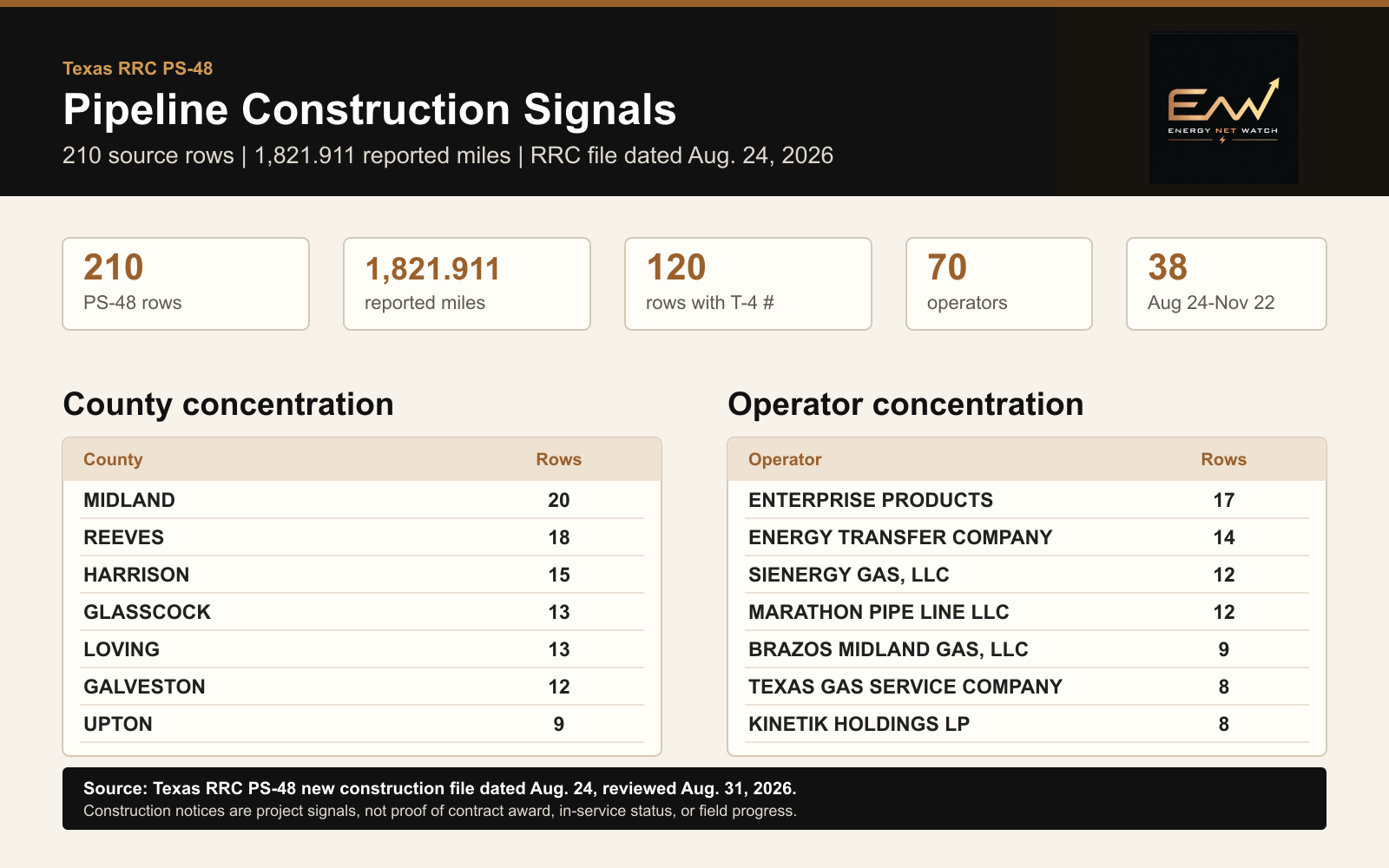
The current image uses the August 24 RRC file and keeps reported construction dates separate from observed field status.
This is not a completion list.
It is a construction-notice review. The value is in separating project names, counties, timing windows, T-4 availability, product type, mileage, and follow-up checks.
What Changed Between The July 20 And August 24 Files
EnergyNetWatch compared exact notification IDs in the two RRC files.
| Measure | July 20 file | August 24 file | Change |
|---|---|---|---|
| PS-48 source rows | 173 | 210 | +37, or 21.4% |
| Reported miles | 1,548.811 | 1,821.911 | +273.100, or 17.6% |
| Unique source-filed operator names | 62 | 70 | +8 net |
| Rows with usable T-4 numbers | 102 | 120 | +18 |
| T-4-number share | 59.0% | 57.1% | -1.9 percentage points |
The August 24 file contains 37 notification IDs that were not present in the July 20 file. No July 20 notification IDs disappeared. The additions span received dates from July 23 through August 21, cover 273.10 source-reported miles across 20 source-filed operator names, and include 18 rows with usable reported T-4 numbers.
These are changes in the published PS-48 file. They do not establish that construction started, remained on schedule, finished, or entered service.
How to use Texas PS-48 notices for a sales territory
Start with the counties your team serves. Then filter by the kind of work you supply: gathering, transmission, distribution or liquids infrastructure. Review the reported diameter and mileage to decide whether the stated scope fits your business.
Keep the operator's filed name and notification ID attached to each record. Use the stated start date to prioritize verification, and retain the source-file date so an old notice does not look like a fresh project update.
A T-4 number can provide another route into system and mapping research. Check whether the system evidence actually corresponds to the notice's scope; a shared permit number does not establish that every mapped segment is the proposed construction.
The result should be a short review list with a reason for including each record and a clear next check. Confirm project status and procurement through appropriate company sources before treating the row as a sales opportunity.
Review the dated Texas project sample. It shows the fields and verification links before you request a territory-specific review.
What Changed Between The June 8 And July 20 Files
EnergyNetWatch compared notification IDs in the two RRC files.
| Measure | June 8 file | July 20 file | Change |
|---|---|---|---|
| PS-48 source rows | 144 | 173 | +29, or 20.1% |
| Reported miles | 1,348.421 | 1,548.811 | +200.390, or 14.9% |
| Unique source-filed operator names | 55 | 62 | +7 net |
| Rows with usable T-4 numbers | 85 | 102 | +17 |
| T-4-number share | 59.0% | 59.0% | Flat when rounded to one decimal |
The July 20 file contains 29 notification IDs that were not present in the June 8 file. No June 8 notification IDs disappeared from the July 20 file.
The 29 added rows cover 200.39 reported miles across 16 source-filed operator names. Seventeen include a usable T-4 number and 12 do not.
These are changes in the published PS-48 file. They do not establish that construction started, remained on schedule, finished, or entered service.
Product Mix In The August 24 File
| Product type | Rows | Reported miles |
|---|---|---|
| Natural gas gathering | 107 | 585.11 |
| Natural gas transmission | 45 | 872.96 |
| Hazardous liquid transmission | 27 | 214.791 |
| Natural gas distribution | 23 | 108.05 |
| Hazardous liquid gathering | 8 | 41.00 |
What PS-48 Records Can Show
| Source field | Why it matters |
|---|---|
| Operator name | Gives the first account or system label to check. |
| Project or system name | Can point to a lateral, expansion, corridor, customer tie-in, or named line. |
| Product type | Separates gathering, transmission, distribution, and liquids work. |
| Diameter | Helps separate small local work from larger corridor or capacity signals. |
| Reported mileage | Shows whether the record is a short lateral, county-level buildout, or multi-county corridor. |
| County list | Turns the record into a territory and nearby-activity check. |
| Stated construction start | Creates a timing window, but still needs current-status review. |
| T-4 number when present | Gives a route/system handle for deeper RRC and GIS review. |
What The Record Does Not Prove
| Not proven | Why not |
|---|---|
| Contract award | PS-48 does not identify vendor awards. |
| Spend or project value | Mileage and diameter are not CAPEX. |
| In-service status | A construction notice is not an operation record. |
| Exact route geometry | Route evidence needs T-4/GIS/detail review. |
| Field progress | The start date may be stale or revised. |
| Full commercial relationship | The record may not identify every producer, shipper, facility, or counterparty. |
That caveat is the point. A useful public record does not have to prove everything. It has to make the next check clear.
How EnergyNetWatch Turns PS-48 Into A Workflow
EnergyNetWatch uses the PS-48 row as the starting point, then organizes the follow-up:
| Step | EnergyNetWatch layer |
|---|---|
| 1 | Apply the published timing boundary and retain the qualifying construction notices. |
| 2 | Group records by operator, project name, county, product type, mileage, and diameter. |
| 3 | Separate started, 0-30 day, 31-60 day, 61-90 day, and later timing windows. |
| 4 | Check T-4, GIS, route, plant, interconnect, meter station, compressor station, and nearby activity context. |
| 5 | Build a review list for sales, business development, service, fabrication, automation, measurement, and midstream teams. |
The public page shows the shape of the workflow. The app workspace carries the exact rows, current source dates, filters, exports, alerts, and API-ready fields.
Selected PS-48 Rows With Named Counties
| Notification | Operator | Project/system | Counties | Reported start | Miles | Diameter | T-4 |
|---|---|---|---|---|---|---|---|
| NOTIF-011372 | Targa NGL Pipeline Company LLC | Cayman Pipeline (HGC-BC) | Chambers; Harris | Oct. 1, 2026 | 27.0 | 30 in. | 10743 |
| NOTIF-011504 | Enterprise Products Operating LLC | Wildfire Loop to Newberry PL | Glasscock; Midland | Sept. 1, 2026 | 26.0 | 20 in. | — |
| NOTIF-011593 | Medallion Operating Company, LLC | WC-1000-10 | Glasscock | July 28, 2026 | 13.8 | 16 in. | — |
| NOTIF-011605 | Enterprise Products Operating LLC | 20-inch Royal Flush to Hornet | Ward | Oct. 1, 2026 | 11.4 | 20 in. | — |
| NOTIF-011358 | Low Carbon Logistics CCS Trans | TX-245 Rose CCS, 20-inch | Jefferson | Aug. 17, 2026 | 10.8 | 20 in. | 10496 |
These rows are public proof points, not final account claims.
For example, a 42-inch transmission row across multiple counties deserves a different review than a short lateral. A row with a T-4 number deserves a route/system check. A row without a T-4 number may still matter, but the follow-up starts with the project name, operator label, counties, product type, and source document.
County Concentration
The current packet points to a broad Texas infrastructure review, but several counties appear more often than others.
| County | PS-48 mentions |
|---|---|
| Midland | 20 |
| Reeves | 18 |
| Harrison | 15 |
| Glasscock | 13 |
| Loving | 13 |
| Galveston | 12 |
| Upton | 9 |
| Ward | 9 |
| San Augustine | 7 |
| Martin | 5 |
| Reagan | 5 |
County concentration matters because the same source row can be checked against nearby wells, permits, production, facilities, plants, interconnects, and route evidence.
Operator Concentration
| Operator | PS-48 rows |
|---|---|
| Enterprise Products Operating LLC | 17 |
| Energy Transfer Company | 14 |
| SiEnergy Gas, LLC | 12 |
| Marathon Pipe Line LLC | 12 |
| Brazos Midland Gas, LLC | 9 |
| Texas Gas Service Company | 8 |
| Kinetik Holdings LP | 8 |
| Pickton Gas Storage LLC | 7 |
| Delaware Basin Midstream LLC | 6 |
| EOG Resources, Inc. | 5 |
The count is only the starting point. A five-row operator with near-term starts, large diameter, or strong county concentration may deserve more attention than a larger operator with older or lower-specificity records.
Who Might Use This
Service teams can use the timing window and county list to decide which projects are worth checking before outreach.
Measurement, automation, controls, and SCADA teams can look for larger transmission, gathering, tie-in, and blending records that need deeper route and facility review.
Fabrication and construction-support teams can use mileage, diameter, product type, and county spread to decide which rows deserve a project file.
Midstream teams can use the same record to check route evidence, interconnect context, and nearby upstream activity.
Analysts can use the caveats to avoid overstating what a construction notice proves.
View the TX/NM Midstream Project Signals report for the current qualified register, named-project evidence, companion export, and app workspace.
For a lower-friction first step, request the current PS-48/T-4 sample report. Ask for the current source date, qualified register, T-4 status split, county/operator rollups, and evidence notes.
If the job is recurring rather than a one-time review, the Texas drilling permits API supports structured permit workflows, while the infrastructure signals API is the more direct path for facility and infrastructure lead signals. Use the public PS-48 page to understand the record and its limits; use the report, app, or API path when the workflow needs current rows, filters, exports, or alerts.
Review the records for your territory
Tell us the Texas counties or operators you follow and the services you supply. Request a scoped review of the available pipeline records, with reported timing, source links and verification notes. We will confirm coverage and delivery scope before quoting the work.
Request a Texas territory review.
For software workflows, compare prepaid API access. API usage and custom research are priced separately.
Frequently Asked Questions
What is a Texas PS-48 record?
In this workflow, PS-48 refers to Texas RRC new pipeline construction notice records used to identify construction-stage pipeline signals. EnergyNetWatch reviews those records as source rows, then organizes project, operator, county, product, timing, and T-4 context.
Is PS-48 the same as T-4?
No. T-4 is the pipeline permit/system route layer EnergyNetWatch checks when a T-4 number or route evidence is available. PS-48 is useful because it can add construction-stage context before every route or field-progress question is resolved.
Does a PS-48 row prove construction is active?
No. It creates a record to check. The stated start date, T-4 status, route evidence, facility context, and current source status still need review.
Why publish this publicly?
Because the public row is only part of the value. The useful work is connecting the row to a published qualification window, evidence limits, related records, and a current project register.
Sources
Data notes
EnergyNetWatch checked the Texas RRC PS-48 file dated August 24, 2026 on August 31 and reconciled it against the immutable July 20 staging snapshot. The current file contains 210 rows and 1,821.911 reported miles; the notification-ID comparison found 37 additions and no removals. The 92 rows totaling 710.29 reported miles remain the separately dated August 22 report boundary, not the complete current file. Named company and federal projects remain separate evidence classes. Reported mileage, dates, T-4 availability, operator counts, and county mentions are source-derived fields, not claims of spend, contract award, in-service status, exact route geometry, or current field progress.
Recommended next pages
Texas PS-48 Pipeline Construction Signals: June 2026 Source Review
June 2026 Texas PS-48 source review with 144 construction-notice rows, 1,348.4 reported miles, timing windows, product mix, operator concentration, county concentration, and T-4 status.
Texas T-4 Pipeline Permit Watchlist: RRC Routes, Counties & Operators
Track Texas RRC T-4 pipeline permit rows by operator, county, commodity, source clock, route evidence, and current table availability.
Texas T-4 Pipeline Permit Watchlist: June 2026 Source Review
June 2026 Texas RRC T-4 source review with operators, counties, commodity mix, source-clock caveats, and route-evidence request path.
T-4 Permit Search | Texas RRC Pipeline Permits & GIS Routes
Search Texas RRC T-4 permits by operator, county, and route. Review GIS evidence, source dates, and related PS-48 construction records.
Related EnergyNetWatch pages
Want the current T-4 or PS-48 sample report?
Public articles use selected examples. Request the current signal report if your team needs the current rows, source dates, T-4 status, county/operator rollups, companion CSV, and verification notes.