
Texas T-4 Pipeline Permit Watchlist: RRC Routes, Counties & Operators
Track Texas RRC T-4 pipeline permit rows by operator, county, commodity, source clock, route evidence, and current table availability.
By Johnathan · Reviewed by EnergyNetWatch Research · Maintained page · Content updated 2026-08-31
Recurring watchlist
This page is part of the recurring EnergyNetWatch signal library. Durable watchlist pages are refreshed as source records change.
Key Takeaways
- The statewide permit-list clock and county GIS refresh clock are separate and should not be presented as one statewide update.
- The August 21 statewide PDF contains 61 physical rows and 60 unique identifiers after counting the duplicate 10744 row once; the unique set includes 47 gas and 13 liquid records through 10798.
- The July 27 GIS review found eight exact T-4 identifiers across Austin, Chambers, Lee, Reeves, and Upton above the older PDF sequence; those identifiers appear in the August 21 statewide PDF as well.
- GIS presence does not establish a permit issue date, construction start, completion, in-service status, capacity, or commercial award.
Texas T-4 pipeline permit searches usually start with a permit number, an operator name, or a county.
The EnergyNetWatch watchlist is built for the next step: turning the current Railroad Commission of Texas T-4 new-permit list into a recurring infrastructure signal that can be reviewed by operator, county, commodity, classification, source date, and route-evidence status.
The watchlist does not treat a T-4 permit as proof of construction, in-service status, capacity, economics, or counterparty exposure. It treats the record as a source-backed pipeline infrastructure lead that may deserve follow-up.
That distinction is important. A Texas drilling permit points to planned well activity. A Texas T-4 permit points to pipeline infrastructure context. For midstream, service, commercial, land, analyst, and data users, the next step is checking whether the row has enough operator, county, commodity, source-date, and route context to support follow-up.
Current Verified T-4 Signal
EnergyNetWatch checked the RRC new-permits page and its linked 2026 PDF on August 31, 2026. The current statewide PDF is dated August 21, 2026. The separate county GIS review below was refreshed July 27, 2026.
| Current signal | Verified value |
|---|---|
| Unique T-4 identifiers in the August 21 statewide PDF | 60 |
| Gas / liquid identifiers | 47 / 13 |
| Highest identifier listed | 10798 |
| County mentions across listed identifiers | 101 across 73 named counties |
| Latest statewide PDF source clock | August 21, 2026 |
| Latest EnergyNetWatch county GIS refresh | July 27, 2026 |
| Counties in that GIS refresh | Austin, Chambers, Lee, Reeves, and Upton |
The statewide PDF keeps the permit-list baseline current through its August 21 source clock. It contains 61 physical data rows but 60 unique identifiers because permit 10744 appears twice with the same source fields. The PDF does not include a per-row issue-date field, so the 60-identifier count is a deduplicated source-list snapshot rather than a count of permits issued on one known day.
What Changed Since The July 9 Baseline
The July 9 RRC PDF listed 51 unique identifiers, including 40 gas and 11 liquid records, with a highest identifier of 10789. The August 21 PDF lists 60 unique identifiers, including 47 gas and 13 liquid records, with a highest identifier of 10798.
The change is nine additional unique identifiers in the statewide list: seven gas identifiers and two liquid identifiers. The most frequent exact source-filed operator labels remain Marathon Pipe Line LLC and ONEOK NGL Pipeline, L.L.C. with three identifiers each. Civitas Permian Operating, LLC, Ballard Exploration Company, Inc., Pickton Gas Storage LLC, Brookston Energy, Inc., and Moriah Operating, LLC each appear twice.
Chambers is the most frequently mentioned county with four identifiers. Ward, Jefferson, Midland, Nacogdoches, and Galveston each appear three times. Those are source-list concentrations, not measures of construction progress, capacity, production, or spend.
The July 27 GIS review found eight exact identifiers above the older 10767 PDF sequence. All eight appear in the August 21 statewide PDF as well. The GIS review still matters because it supplies a separate mapped source surface; it should not be merged with the statewide PDF into one issue-date or construction claim.
July 27 Five-County GIS Review
EnergyNetWatch refreshed the RRC county pipeline GIS files for Austin, Chambers, Lee, Reeves, and Upton counties on July 27, 2026.
At the time of this comparison, the reference PDF carried an Apr. 15 source clock and ended at 10767. The current August 21 PDF is summarized above. The GIS review and statewide PDF remain separate source surfaces with separate clocks.
| Review item | July 27 result |
|---|---|
| County GIS files successfully refreshed | 5 |
| Exact T-4 identifiers above the PDF sequence | 8 |
| Gas transmission records | 3 |
| Gas gathering records | 2 |
| Liquids / production records | 3 |
| Largest RRC-recorded outside diameters | 28 in. and 24 in. |
| County GIS refresh | July 27, 2026 |
| Reference PDF clock used in the July 27 comparison | Apr. 15, 2026 |
| Current statewide PDF clock | August 21, 2026 |
| T-4 | Operator / system | County | Service | RRC recorded outside diameter | GIS rows |
|---|---|---|---|---|---|
| 10789 | MAGNETAR OPERATING LLC / TURNER UNIT | Chambers | Gas gathering | 3.5 in. | 1 |
| 10788 | ONEOK NGL PIPELINE, L.L.C. / MONT BELVIEU | Chambers | Liquids / production segments | 6.63, 8.63, 10.75, 12.75 in. | 19 |
| 10783 | ONEOK NGL PIPELINE, L.L.C. / MONT BELVIEU | Chambers | Liquids | 6.63, 8.63 in. | 2 |
| 10782 | ONEOK NGL PIPELINE, L.L.C. / MONT BELVIEU | Chambers | Liquids | 6.63 in. | 1 |
| 10781 | AMP INTRASTATE PIPELINE, LLC / ASPEN KATY HUB GAS TRANSMISSION LINE | Austin | Gas transmission | 24 in. | 1 |
| 10776 | PECOS POWER PLANT LLC / SALSBURY PECOS | Reeves | Gas transmission | 10.75 in. | 1 |
| 10771 | MPH BASTROP LATERAL, LLC / MPH BASTROP LATERAL | Lee | Gas transmission | 28 in. | 1 |
| 10768 | CGP OPERATING, LLC / BENEDUM | Upton | Gas gathering | 6.63 in. | 1 |
Outside-diameter values are shown as recorded in the RRC county pipeline GIS. Multiple values mean the T-4 identifier matched mapped segments with different recorded diameters.
This is not a complete statewide delta. Current GIS presence does not establish when a permit was issued. It also does not prove construction, completion, in-service status, capacity, route ownership, project spend, procurement, or an award.
Current Statewide 2026 PDF Baseline
The separate statewide baseline uses the RRC 2026 New Pipeline Permits PDF available from the RRC new-permits page when checked on August 31, 2026.
| Watchlist item | Current signal |
|---|---|
| Current 2026 unique T-4 identifiers | 60 |
| Gas identifiers | 47 |
| Liquid identifiers | 13 |
| County mentions across listed identifiers | 101 |
| Source clock | RRC list last updated August 21, 2026 |
| Per-row issue dates in YTD PDF | Not included |
| Duplicate treatment | Permit 10744 counted once |
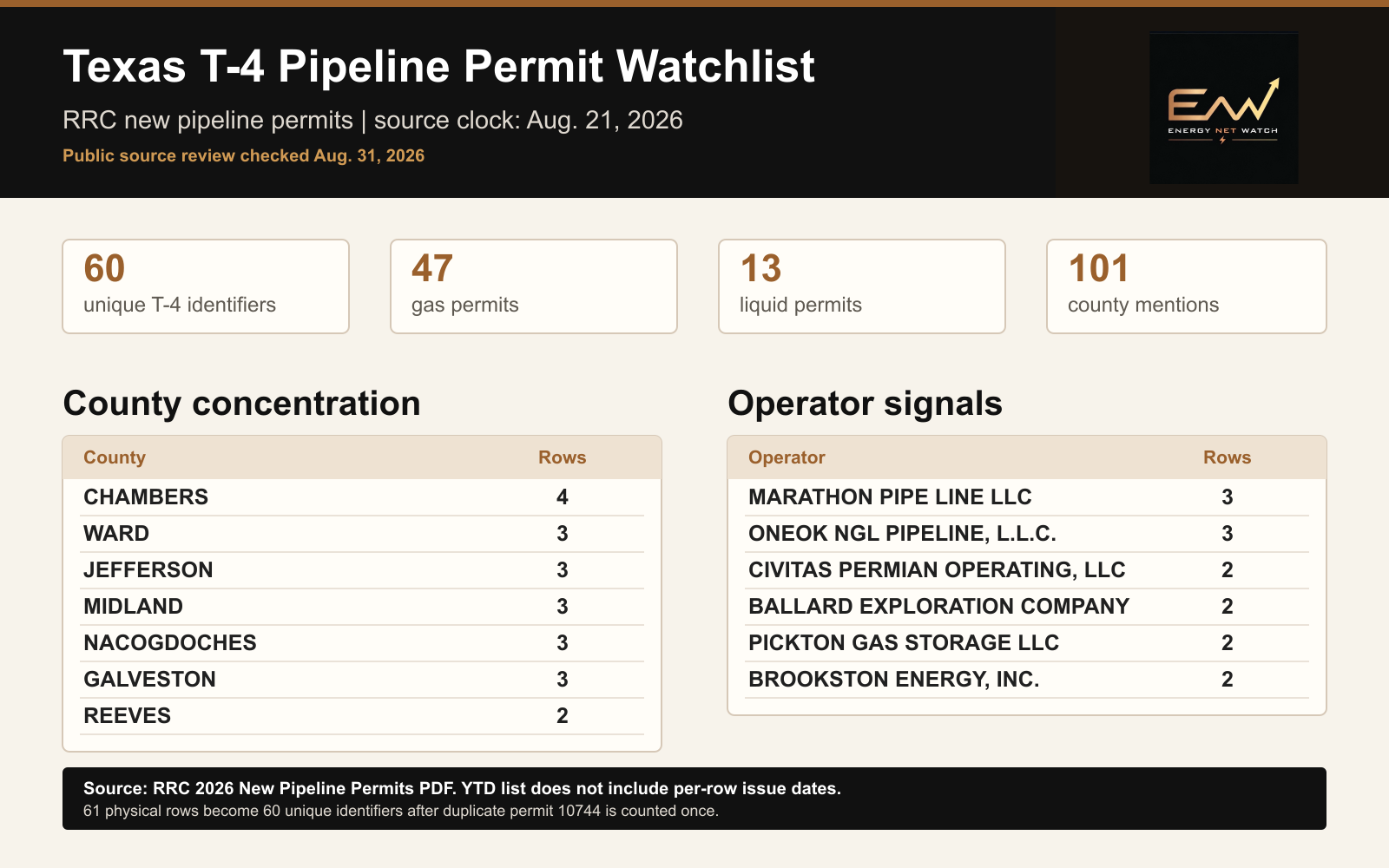
EnergyNetWatch public T-4 watchlist snapshot from the RRC 2026 New Pipeline Permits PDF dated August 21. The graphic uses unique identifiers, counts the duplicate 10744 row once, and does not imply per-row issue dates that are not present in the YTD PDF.
The statewide list remains a source-clock baseline. County GIS refreshes can add newer route evidence, but they should not be presented as statewide permit-list movement without comparable coverage and permit issue dates.
Why A Watchlist Is Better Than A One-Off Article
The evergreen Texas RRC T-4 pipeline permit explainer answers the searcher's first question: what a Texas RRC T-4 pipeline permit is, how GIS route evidence fits, and why a source row needs context.
The watchlist answers a different question: what the current source list shows and which records deserve review.
Those are separate jobs.
The explainer should stay stable. The watchlist should change as the source changes.
That gives EnergyNetWatch a cleaner public content system:
| Page type | Job |
|---|---|
| T-4 permit explainer | Explain the source, search process, GIS route evidence, and workflow |
| T-4 watchlist hub | Maintain the current baseline and archive recurring reviews |
| Dated T-4 source review | Highlight the current operator, county, commodity, and classification signals |
| LinkedIn/X signal | Pull one record or trend into a short public post |
This structure gives search users a stable answer and gives repeat readers a reason to come back when the source list changes.
How To Read A T-4 Signal
A T-4 signal is strongest when the source row can be tied to a specific operator, county set, commodity, classification, source clock, and route-evidence status.
| T-4 field | What to check next |
|---|---|
| Operator / P-5 | Confirm source label and account match |
| County list | Check concentration, nearby wells, permits, and facilities |
| Commodity | Separate gas, liquid, and other pipeline context |
| Classification | Keep private, common carrier, and gas utility rows separate |
| Source clock | Confirm whether the row is current enough for follow-up |
| Route evidence | Check whether the row has mapped GIS context |
What The Watchlist Tracks
The Texas T-4 watchlist is designed around public-record fields that can support a real business follow-up.
| Field | Why it matters |
|---|---|
| T-4 permit number | Gives the record a source identifier for review and lookup |
| Operator or applicant | Supports account screening and operator-level monitoring |
| P-5 number | Helps distinguish similar operator names |
| Commodity | Separates gas, liquid, and other pipeline context |
| Classification | Helps separate private, common-carrier, gas-utility, and other record types |
| County list | Shows where the infrastructure signal is located |
| Source clock | Prevents stale records from being presented as current activity |
| GIS route evidence | Adds spatial context when a route match is available |
The watchlist should not flatten those fields into one generic activity number. A gas/private row in Reeves County, a common-carrier liquid row across Culberson, Loving, and Winkler, and a gas-utility row across several counties can all matter, but they do not mean the same thing.
Current County And Operator Signals
In the current August 21, 2026 public list, Chambers appears four times. Ward, Jefferson, Midland, Nacogdoches, and Galveston each appear three times. Brooks, Webb, Zapata, Crane, Liberty, Upton, Wharton, Nueces, Reeves, and several other counties each appear twice.
| County | Current rows |
|---|---|
| Chambers | 4 |
| Ward | 3 |
| Jefferson | 3 |
| Midland | 3 |
| Nacogdoches | 3 |
| Galveston | 3 |
The operator view is distributed. Marathon Pipe Line LLC and ONEOK NGL Pipeline, L.L.C. each appear three times. Civitas Permian Operating, LLC, Ballard Exploration Company, Inc., Pickton Gas Storage LLC, Brookston Energy, Inc., and Moriah Operating, LLC each appear twice. Most other exact source-filed labels appear once.
| Operator | Current rows |
|---|---|
| Marathon Pipe Line LLC | 3 |
| ONEOK NGL Pipeline, L.L.C. | 3 |
| Civitas Permian Operating, LLC | 2 |
| Ballard Exploration Company, Inc. | 2 |
| Pickton Gas Storage LLC | 2 |
| Brookston Energy, Inc. | 2 |
This is where the watchlist becomes stronger than a static list. If a future RRC update adds new rows, EnergyNetWatch can separate the current additions from the baseline and show whether a county or operator is moving above its recent average.
Example Records Worth Reviewing
Three records in the current list show why a T-4 watchlist should be more than a count.
| Record | Why it is worth review |
|---|---|
| Enterprise Products Operating LLC in Martin and Midland counties | Large midstream operator, gas/private classification, and Midland Basin county context |
| Diamondback E&P LLC in Midland County | Operator-linked infrastructure context that can be checked alongside drilling and well activity |
| Plains Pipeline L.P. in Culberson, Loving, and Winkler counties | Liquid/common-carrier row across core Delaware Basin counties |
None of those rows should be presented as a completed project by themselves. The next step is review: route match, permit detail, source documents, related wells, nearby drilling permits, facility records, and whether the record supports an account, project, or API workflow.
How Weekly Movement Should Be Scored
When new source snapshots are available, the watchlist should score the update with more context than a raw count.
| Metric | Use |
|---|---|
| This update | Number of new or changed rows in the latest source snapshot |
| Rolling 90-day average | Baseline that makes the current count meaningful |
| Fast movers | Operators with the largest increase in T-4 activity |
| Emerging counties | Counties moving above their recent baseline |
| Commodity mix | Gas, liquid, or other row share |
| Classification mix | Private, common carrier, gas utility, or other classifications |
| Route evidence | Which rows have confirmed or candidate GIS context |
The page should make clear whether a source update is normal, concentrated, or worth immediate follow-up.
What The Watchlist Does Not Prove
The watchlist is intentionally conservative.
| Not proven by the watchlist alone | Why |
|---|---|
| In-service status | A listed T-4 permit row does not confirm active operation |
| Construction completion | Additional source review may be required |
| Final route certainty | GIS evidence must be matched and reviewed |
| Capacity or economics | T-4 permit rows do not provide a commercial valuation |
| Complete counterparty exposure | The public row does not identify every commercial relationship |
This caveat is not a weakness. It is the difference between a public-record lead and an unsupported claim.
Request The Current T-4 Route Evidence Table
The public watchlist shows enough to validate the workflow. The full EnergyNetWatch workflow is built for users who need the table, route evidence, operator grouping, county context, exports, alerts, or API access.
View the Texas Pipeline Construction Signal Report package if your team wants the current T-4 table, route review, county/operator rollups, map context, exports, or API-ready infrastructure records.
For a smaller first request, ask for the current T-4 route-evidence sample. Include the counties, operators, or commodity types your team wants checked.
Choose The Next T-4 Workflow
The right next step depends on whether you are verifying one public record or monitoring a recurring signal.
| Search or workflow intent | Best next path |
|---|---|
| Verify a permit number, operator, or county record | Start with the RRC New Pipeline Permits source, then use the T-4 route-evidence explainer. |
| Review current T-4 rows by operator, county, commodity, or source clock | Use this watchlist and its dated archive. |
| Monitor drilling or permit activity through a recurring API workflow | Review the Texas drilling permits API and infrastructure signals API paths. |
| Receive a ranked infrastructure review with route context and exports | Use the Texas Pipeline Construction Signal Report or request a sample. |
This keeps a one-time source lookup separate from a current watchlist, a ranked report, or a repeatable API/alert workflow.
Latest Watchlist Archive
- Texas T-4 Pipeline Permit Watchlist — June 2026
- Texas RRC T-4 pipeline permits: route evidence and operator signals
- Texas PS-48 pipeline construction signals
- Texas T-4 pipeline permits: how midstream infrastructure leads work
- Texas T-4 Pipeline Permit glossary definition
- Midstream infrastructure data
Frequently Asked Questions
Is the Texas T-4 watchlist a replacement for RRC search?
No. The RRC remains the source system. The EnergyNetWatch watchlist organizes public source records into operator, county, commodity, classification, source-clock, map, export, alert, and API workflows.
Why does the watchlist show a source clock?
The source clock prevents a public-record list from being mistaken for live operational activity. The statewide PDF linked by the RRC was last updated August 21, 2026 and checked by EnergyNetWatch on August 31. Five county GIS files were refreshed separately on July 27. Those clocks describe different source surfaces and should not be combined into a false statewide update.
Can this be updated weekly?
Yes, when the RRC source page or related source records update. The first watchlist establishes the baseline. Future updates can compare new snapshots against the prior snapshot and rolling averages.
Does a T-4 permit mean a pipeline is operating?
No. A T-4 row is a pipeline permit record. It may support an infrastructure lead or route-evidence review, but it does not by itself prove in-service status, construction completion, economics, or final project scope.
Sources
- Railroad Commission of Texas: New Pipeline Permits
- Railroad Commission of Texas: August 21, 2026 New Pipeline Permits PDF
- Railroad Commission of Texas: How to Search for T-4 Permits
- Railroad Commission of Texas: Pipeline Safety Permitting and Mapping
- Railroad Commission of Texas: Public GIS Viewer
- Railroad Commission of Texas: Data Sets Available for Download
Data notes
EnergyNetWatch checked the official RRC 2026 New Pipeline Permits PDF on August 31, 2026; its footer says it was last updated August 21, 2026. The PDF contains 61 physical rows and 60 unique identifiers after permit 10744 is counted once: 47 gas identifiers, 13 liquid identifiers, and a highest listed identifier of 10798. It does not include per-row issue dates. EnergyNetWatch separately refreshed Austin, Chambers, Lee, Reeves, and Upton county pipeline GIS files on July 27, 2026 and found eight exact identifiers above the older 10767 sequence. This is a five-county GIS review, not a complete statewide GIS delta, and GIS presence does not establish a permit issue date.
Recommended next pages
Texas T-4 Pipeline Permit Watchlist: June 2026 Source Review
June 2026 Texas RRC T-4 source review with operators, counties, commodity mix, source-clock caveats, and route-evidence request path.
T-4 Permit Search | Texas RRC Pipeline Permits & GIS Routes
Search Texas RRC T-4 permits by operator, county, and route. Review GIS evidence, source dates, and related PS-48 construction records.
Texas T-4 Pipeline Permits: How Midstream Infrastructure Leads Work
Texas T-4 pipeline permits can become midstream infrastructure leads when matched to route, operator, county, and source context.
Oil And Gas Infrastructure Records: Facility Evidence vs Lead Signals (2026)
EnergyNetWatch separates oil and gas infrastructure records by evidence basis: Texas facility permits, New Mexico leads, T-4 signals, and state-source leads.
Related EnergyNetWatch pages
Query the current records with an API key
Start with $50 in prepaid API credits and create the key yourself. Use request access only when the job needs a custom report, delivery scope, or team agreement.