
Texas T-4 Pipeline Permit Watchlist: June 2026 Source Review
June 2026 Texas RRC T-4 source review with operators, counties, commodity mix, source-clock caveats, and route-evidence request path.
By Johnathan · Reviewed by EnergyNetWatch Research · Historical report
Historical report
This page is a historical source-record snapshot tied to a specific company update or activity event. It links back into durable operator and state workflows.
Key Takeaways
- The RRC 2026 New Pipeline Permits PDF available on June 21, 2026 carries an Apr. 15, 2026 source-clock footer.
- Midland appears three times in the baseline, while Brooks, Zapata, Crane, Wharton, and Nueces each appear twice.
- Enterprise Products, Diamondback, Plains, Nile Midstream, and Civitas rows are review candidates, not proof of construction or in-service status.
The current Texas T-4 pipeline permit signal is not a single operator story yet. It is a source-clock baseline.
This page is the dated June 2026 source review.
Use the durable Texas T-4 Pipeline Permit Watchlist for the ongoing editorial page. Use the Texas Pipeline Construction Signal Report package when the job is the current table, route review, CSV, or request path.
EnergyNetWatch reviewed the Railroad Commission of Texas 2026 New Pipeline Permits PDF available on June 21, 2026. The linked 2026 list is marked by the RRC as last updated Apr. 15, 2026 and contains 29 current 2026 T-4 permit rows after correcting PDF extraction splits in the visible permit-number sequence.
That matters because the search interest is real. Searches for RRC T-4 permit search, T4 permit search, RRC T-4 permit, and Texas pipeline permit GIS all point to the same need: a permit row that can be checked by operator, county, commodity, route evidence, and source date.
Current Texas T-4 Source Review
| Metric | Current signal |
|---|---|
| Source family | RRC New Pipeline Permits |
| Source list | 2026 New Permits PDF |
| RRC list footer date | Apr. 15, 2026 |
| EnergyNetWatch review date | June 21, 2026 |
| Current 2026 T-4 rows | 29 |
| Gas permit rows | 24 |
| Liquid permit rows | 5 |
| County mentions across rows | 39 |
| Per-row issue dates in YTD PDF | Not included |
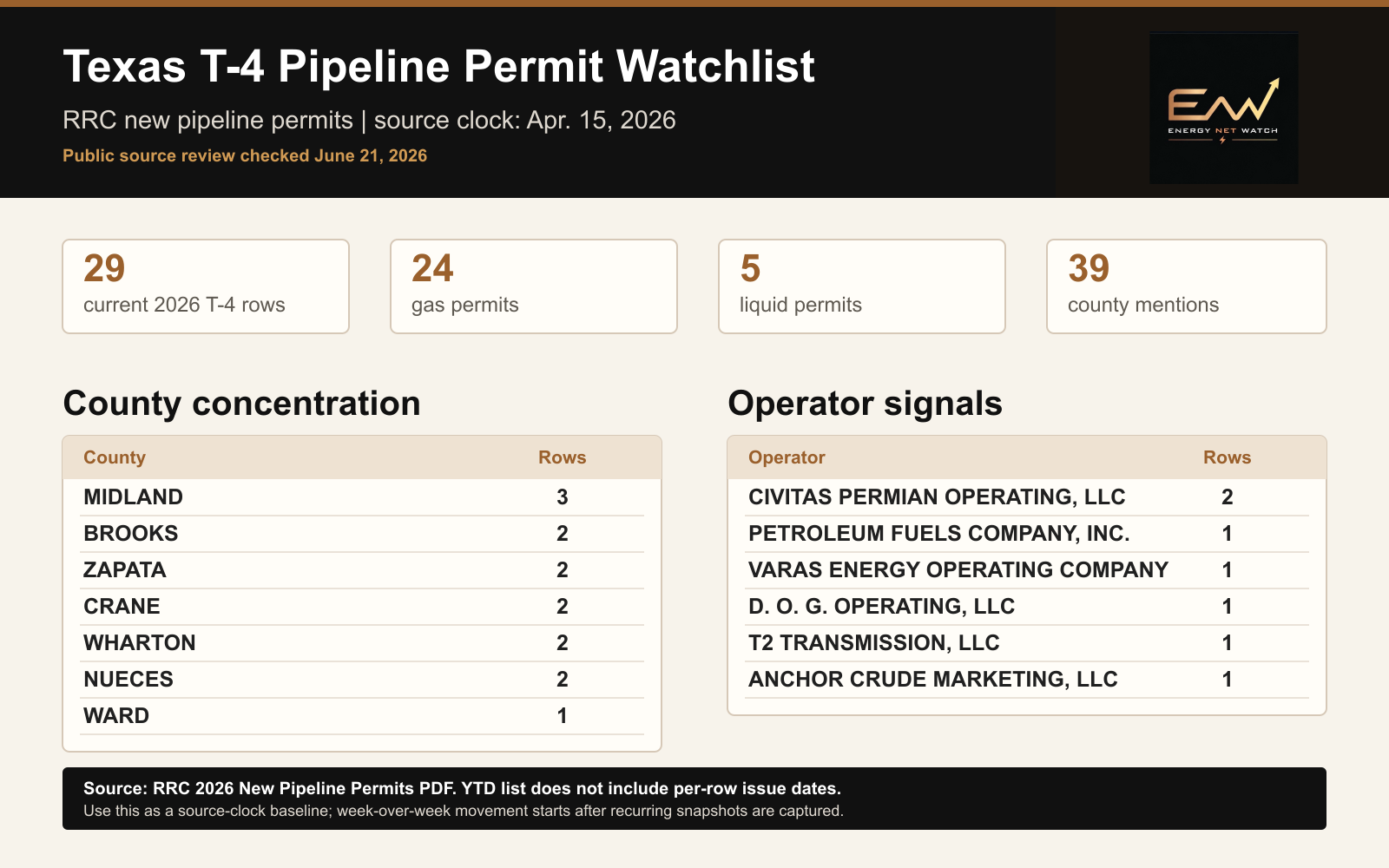
EnergyNetWatch public watchlist snapshot from the RRC 2026 New Pipeline Permits PDF. The source list is a T-4 baseline, but the YTD PDF does not include per-row issue dates.
Use this as the first watchlist baseline. A future update can show what changed from this baseline once the RRC source list changes or another approved source table supplies row-level dates.
Lead Signal
The current list is weighted toward gas/private pipeline records, with Midland appearing three times and Civitas Permian Operating, LLC appearing twice.
That does not make Midland the only county worth watching. It means the current public baseline has enough Midland and operator-linked context to support follow-up once route evidence, nearby drilling permits, reported spuds, production context, and facility records are connected.
The review starts with one question:
Which current T-4 records are specific enough to become an operator or county follow-up workflow?
That is different from asking how many rows are in the PDF.
Commodity And Classification Mix
The current 2026 public list has 24 gas rows and 5 liquid rows.
| Commodity | Rows | Signal |
|---|---|---|
| Gas | 24 | Dominant current public signal in the baseline list |
| Liquid | 5 | Smaller set, but important where common-carrier or multi-county context appears |
The classification mix is also important. A gas/private row, gas-utility row, liquid/common-carrier row, and liquid/private row should not be treated as interchangeable.
| Classification | Watchlist signal |
|---|---|
| Private | Most common visible classification in the baseline |
| Common Carrier | Smaller but commercially meaningful liquid subset |
| Gas Utility | Utility-style gas rows requiring separate interpretation |
The public source record gives enough context to separate those categories. It does not give enough context to claim in-service status, final route status, construction timing, or commercial exposure.
County Concentration
Midland is the clearest county concentration in the current baseline, with three listed rows. Brooks, Zapata, Crane, Wharton, and Nueces each appear twice.
| County | Current rows |
|---|---|
| Midland | 3 |
| Brooks | 2 |
| Zapata | 2 |
| Crane | 2 |
| Wharton | 2 |
| Nueces | 2 |
This is not a ranking of pipeline mileage or project value. It is a source-record concentration signal from the current T-4 list.
For business development, the county signal can become a follow-up list:
| Follow-up question | Why it matters |
|---|---|
| Which operators appear in the county? | Turns a county signal into account targeting |
| Is the record gas or liquid? | Changes the likely buyer and use case |
| Is the row private, common carrier, or gas utility? | Changes how the record should be interpreted |
| Is there route evidence? | Separates a row from a mapped infrastructure workflow |
| Are nearby wells or permits active? | Adds upstream context around the infrastructure signal |
Operator Signals
Civitas Permian Operating, LLC appears twice in the current public baseline. Most other operator labels appear once.
| Operator | Current rows | Current signal |
|---|---|---|
| Civitas Permian Operating, LLC | 2 | Multi-row operator signal; review Glasscock, Howard, and Reeves context |
| Enterprise Products Operating LLC | 1 | Martin/Midland gas/private row worth midstream account review |
| Diamondback E&P LLC | 1 | Midland County gas/private row; stronger when paired with operator activity |
| Plains Pipeline L.P. | 1 | Culberson/Loving/Winkler liquid/common-carrier row |
| Nile Midstream, LLC | 1 | Crane/Midland/Upton liquid/common-carrier row |
This is where the watchlist starts turning into intelligence. A one-row operator signal is not automatically less important than a two-row signal. The value depends on the workflow.
For a midstream team, Plains Pipeline or Nile Midstream may be a strong follow-up because liquid/common-carrier context matters. For an operator-intelligence workflow, Diamondback and Civitas may matter because those labels can be checked against drilling permits, wells, production, and county concentration.
Records To Review First
The current baseline has three public rows that show how the workflow works.
| T-4 row | Source record | Why review first |
|---|---|---|
| Enterprise Products Operating LLC | Gas/private; Martin and Midland counties | Recognizable midstream operator and Midland Basin county context |
| Diamondback E&P LLC | Gas/private; Midland County | Operator-linked infrastructure context that can be paired with drilling and well records |
| Plains Pipeline L.P. | Liquid/common carrier; Culberson, Loving, and Winkler counties | Delaware Basin county set with common-carrier liquid context |
These are not claims of construction or operation. They are candidates for route review, source-document review, map review, and related-record matching.
New Versus Historical Average
This first public watchlist should not invent a week-over-week move. The RRC YTD PDF does not provide per-row issue dates, and EnergyNetWatch is establishing this as the baseline snapshot.
The recurring watchlist should handle movement this way:
| Metric | Current status |
|---|---|
| This source snapshot | 29 current 2026 rows |
| Prior snapshot | Baseline not yet established for public weekly archive |
| Rolling 90-day average | Requires recurring snapshots or row-level issue dates |
| Fast movers | Available after at least two comparable source snapshots |
| Emerging counties | Available after baseline comparison is established |
This may look conservative, but it is the right standard. If a public brief cannot defend the date basis, it should not pretend to show a weekly move.
How EnergyNetWatch Builds On The Source List
The public PDF is the source list, not the finished workflow. EnergyNetWatch adds value by connecting the source row to review fields and related records.
| Source row | EnergyNetWatch workflow layer |
|---|---|
| T-4 permit number | Source identifier for lookup and matching |
| Operator and P-5 | Account and operator-label review |
| Counties | County concentration and map context |
| Commodity/classification | Signal type and buyer-use context |
| GIS route evidence | Route context where matched and reviewed |
| Nearby wells/permits/facilities | Related activity context |
| Export/API workflow | Structured delivery for teams that need repeatable monitoring |
That is where EnergyNetWatch adds value: the public list shows the row; the workflow connects it to account review, route context, exports, and monitoring.
What This Brief Does Not Prove
The current June source review does not prove:
| Not proven | Reason |
|---|---|
| In-service status | T-4 source rows do not by themselves confirm operation |
| Construction completion | Additional source review is required |
| Final route status | Route evidence must be matched and reviewed |
| Project economics | Permit records do not establish value |
| Full commercial relationships | The row does not identify every counterparty or contract |
That caveat should appear in every T-4 watchlist update. It protects trust and makes the eventual full workflow more valuable.
Who Should Care
For midstream and infrastructure teams, the current baseline gives a focused source list for pipeline permit review.
For service and equipment teams, the county/operator split can help identify where infrastructure context may support account follow-up.
For analysts, the distinction between T-4 permits, route evidence, drilling permits, wells, production, and facilities keeps infrastructure records from being overclaimed.
For data and API buyers, the value is repeatability: a current source table, source clock, caveats, map context, exports, alerts, and API-ready fields.
View the Texas Pipeline Construction Signal Report package if your team wants the current T-4 source table, route-evidence review, county/operator rollups, map context, exports, alerts, or API-ready infrastructure records.
Related Pages
- Texas T-4 Pipeline Permit Watchlist
- Texas RRC T-4 pipeline permits: route evidence and operator signals
- Texas PS-48 pipeline construction signals
- Texas T-4 Pipeline Permit glossary definition
- Texas Pipeline Construction Signal Report package
If you need the current route-evidence table rather than this June source snapshot, go to the Texas Pipeline Construction Signal Report package.
If you want to evaluate the format first, request the current T-4 route-evidence sample. Ask for the source clock, current rows, route-evidence fields, and what still needs source-document review.
Frequently Asked Questions
Why is the June 2026 review using an Apr. 15 source clock?
The RRC 2026 New Pipeline Permits PDF available from the official new-permits page when checked on June 21, 2026 is marked as last updated Apr. 15, 2026. The brief reports that source clock instead of implying a newer date.
Why not call this a weekly movement report?
This first watchlist establishes the baseline. A true week-over-week movement report requires a later comparable source snapshot or a source table with row-level issue dates.
Is the RRC T-4 list enough to build a sales lead?
It can be enough to identify a source-backed lead candidate. A stronger sales or commercial workflow should add route evidence, operator context, nearby wells, drilling permits, facility records, and source-document review.
What is the best next EnergyNetWatch request?
Ask for the current Texas T-4 route evidence table. That is more specific than a general demo request and maps directly to the workflow this public brief validates.
Sources
Data notes
EnergyNetWatch reviewed the RRC 2026 New Pipeline Permits PDF linked from the official RRC new-permits page on June 21, 2026. The RRC list footer says it was last updated Apr. 15, 2026. The YTD PDF does not include per-row issue dates. Current-row counts were checked against the visible permit-number sequence in the PDF because PDF text extraction can split selected five-digit permit numbers.
Recommended next pages
Texas T-4 Pipeline Permit Watchlist: RRC Routes, Counties & Operators
Track Texas RRC T-4 pipeline permit rows by operator, county, commodity, source clock, route evidence, and current table availability.
T-4 Permit Search | Texas RRC Pipeline Permits & GIS Routes
Search Texas RRC T-4 permits by operator, county, and route. Review GIS evidence, source dates, and related PS-48 construction records.
Texas T-4 Pipeline Permits: How Midstream Infrastructure Leads Work
Texas T-4 pipeline permits can become midstream infrastructure leads when matched to route, operator, county, and source context.
Oil And Gas Infrastructure Records: Facility Evidence vs Lead Signals (2026)
EnergyNetWatch separates oil and gas infrastructure records by evidence basis: Texas facility permits, New Mexico leads, T-4 signals, and state-source leads.
Related EnergyNetWatch pages
Query the current records with an API key
Start with $50 in prepaid API credits and create the key yourself. Use request access only when the job needs a custom report, delivery scope, or team agreement.